
Is hemp-derived THC legal in 2026? The short answer is yes at the federal level, with a specific 0.3% delta-9 threshold from the 2018 Farm Bill, but the long answer involves state carve-outs, FDA oversight, and a COA you should always read before you buy. This post walks through the actual statute text, the math on a finished gummy, and the practical checks Jessica runs on every batch GummyGurl ships.
What the 2018 Farm Bill actually changed about hemp-derived THC legal status
Before December 2018, the Controlled Substances Act treated every part of the cannabis plant the same. The 2018 Farm Bill (H.R. 2, Section 10113) carved hemp out, defining it as cannabis containing no more than 0.3% delta-9 THC on a dry weight basis, and explicitly removed hemp and its derivatives, extracts, and cannabinoids from Schedule I.
That single number, 0.3%, is the line between a federally legal hemp product and a federally controlled marijuana product. The USDA wrote the implementing rule in 7 CFR Part 990, which governs how growers test, sample, and dispose of crops that go above the threshold. The DEA acknowledged the carve-out in its 2020 interim final rule.
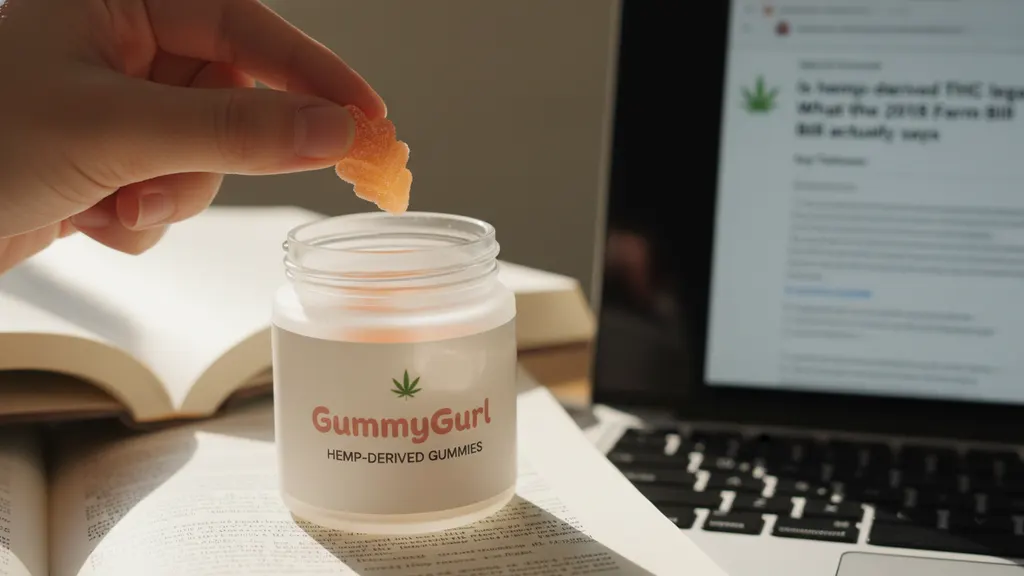
How the 0.3% rule makes a high-dose hemp-derived THC legal gummy possible
The math is the part people skip. 0.3% by dry weight is a ratio, not a milligram cap. On a small candy that ratio is tiny. On a heavier gummy it is more meaningful, and that is the entire reason high-dose hemp gummies exist within federal compliance.
Take a 4-gram gummy. Dry weight is 4,000 milligrams. 0.3% of 4,000 mg equals 12 mg of delta-9 THC per piece, all of it still inside the Farm Bill window. A 5-gram gummy hits 15 mg. Nothing about that math is a loophole, it is a direct application of the statutory definition the USDA published.
Where the FDA and the 2018 Farm Bill diverge on hemp products
The Farm Bill made hemp an agricultural commodity. It did not give the FDA a new pathway to approve hemp-derived ingredients in food, beverages, dietary supplements, or cosmetics. The FDA has been clear about this gap.
In its January 2023 statement on cannabidiol, the agency said the existing food and supplement frameworks were not appropriate for CBD or other hemp cannabinoids and asked Congress for a new pathway. Until that pathway exists, the FDA continues to issue warning letters under its hemp consumer guidance for products that make drug claims, that are marketed to children, or that are sold as dietary supplements.
So a brand can be 100% Farm Bill compliant on the chemistry and still receive an FDA warning letter for the label. The two regimes operate in parallel, not in conflict, and a responsible hemp operator works inside both.
State-by-state restrictions on hemp-derived THC legal sales
Section 10114 of the Farm Bill preserved state authority to restrict hemp within their borders. That is the single most important sentence for buyers, because the rules that decide whether a package can ship to your door live at the state level.
The National Conference of State Legislatures hemp statute tracker keeps a current list. California restricts intoxicating hemp under AB-45 and a 2024 emergency rule that capped detectable THC per serving. Texas operates under DSHS Consumable Hemp Program rules that require registration and ban smokable hemp. Florida runs licensing through the FDACS hemp food establishment permit program.
| State | Hemp-derived THC status | Primary rule source |
|---|---|---|
| California | Permitted with serving caps under AB-45 and 2024 emergency rule | leginfo.legislature.ca.gov |
| Texas | Permitted with DSHS registration, smokable hemp banned | dshs.texas.gov |
| Florida | Permitted under FDACS food establishment permit | fdacs.gov |
| Idaho | Restricted, intoxicating cannabinoids prohibited | NCSL tracker |
| Most other states | Permitted under federal Farm Bill thresholds | ncsl.org |
For a closer look at this, see Is Hemp-Derived Delta-9 THC Legal in Your State? A 2025 Buyer's Guide.
How to read a COA before you buy a hemp-derived THC legal gummy
Federal compliance lives or dies on the Certificate of Analysis. A COA is the lab document that ties a finished batch to its actual cannabinoid potency and contaminant results. If a brand will not show one before purchase, walk away.
Jessica reviews every GummyGurl COA against the same five checks, and the FDA flags the same panels in its consumer hemp guidance. The lab must hold ISO 17025 accreditation. The batch number on the COA must match the one on the package. The delta-9 THC value must be reported in milligrams per piece and as a percentage of dry weight under 0.3%. The four contaminant panels, heavy metals, pesticides, residual solvents, and microbials, must all show passing results.
For more on the lab side, see our internal guide on how to read a hemp COA and the related explainer on delta-9 vs delta-8 THC.
Common myths about hemp-derived THC legal status
Three myths keep showing up in customer service tickets, and all three come from people repeating something they read on a forum instead of the actual statute. The Farm Bill text is short and free at congress.gov, so this is one of the rare cases where reading the source is fastest.
Myth one: "FDA approved hemp gummies exist." They do not. The FDA has approved one cannabis-derived prescription drug, Epidiolex, and that is the entire list. Myth two: "Shipping by USPS is illegal." USPS published mailability standards for hemp in 2019 that allow compliant hemp products with documentation. Myth three: "Any THC means a failed drug test result is unfair." Drug tests look for THC metabolites regardless of the legal source, so a 12 mg compliant gummy can show up on a urine screen. That is a labelling responsibility, not a legality question.

Frequently asked questions
Is hemp-derived THC legal at the federal level in 2026?
At the federal level, hemp-derived THC legal status flows from the 2018 Farm Bill, which removed hemp and its derivatives from the Controlled Substances Act so long as the finished product contains no more than 0.3% delta-9 THC by dry weight. The USDA codified this in 7 CFR Part 990, and the FDA still oversees food, beverage, and cosmetic labelling. So a compliant gummy that tests at or under 0.3% delta-9 THC by dry weight is federally legal, but the agency that enforces against your product depends on category, claims, and the state you ship into.
What does 0.3% delta-9 THC by dry weight actually mean on a gummy?
On a finished gummy, the 0.3% calculation is total delta-9 THC milligrams divided by the dry weight of the piece in milligrams, multiplied by 100. A 4-gram gummy weighs 4,000 mg dry, so 0.3% equals 12 mg of delta-9 THC per piece. The USDA hemp regulations at 7 CFR 990.3 define the standard, and the FDA has reiterated the same threshold for finished hemp products. That is why high-dose gummies tend to be physically larger pieces, not because of any loophole.
Can states ban hemp-derived THC even if it is federally legal?
Yes. Section 10114 of the 2018 Farm Bill explicitly preserves state authority to restrict hemp products within their borders, and the National Conference of State Legislatures tracks an updated map of which states have done so. A handful, including Idaho and parts of the South, restrict or ban intoxicating cannabinoids outright. Others, like California under AB-45 and Texas under DSHS rules, impose age gates, registration, milligram caps, or testing rules. Always check the destination state before ordering, because shipping rules follow the receiving address, not the seller.
What should I look for on a COA before buying hemp gummies?
A trustworthy Certificate of Analysis names the testing lab, lists an ISO 17025 accreditation, ties the result to a specific batch number that matches the printed package, and shows results for cannabinoid potency plus the four contaminant panels the FDA calls out: heavy metals, pesticides, residual solvents, and microbials. The delta-9 THC value should be reported in milligrams per piece and as a percentage of dry weight. If a brand will not show the COA before you buy, treat that as a red flag, not a feature.
Does the FDA approve hemp-derived THC gummies?
No. The FDA has not authorized THC or CBD as a food additive or dietary ingredient, which is why brands cannot make disease claims on labels or marketing. The FDA position, restated in its 2023 statement on CBD, is that a new regulatory pathway is needed. Hemp-derived THC legal status under the Farm Bill is separate from FDA approval. A compliant gummy can be sold lawfully under federal hemp rules while still being subject to FDA warning letters if the brand makes prohibited health claims or sells to minors.