
The first time a batch of full-spectrum gummies came back from the lab over the 0.3 percent delta-9 cap, I pulled the entire run. That single number separates a legal hemp-derived CBD gummy from a federally scheduled product, and it comes up in the CBD vs THC gummies decision more often than buyers realize. One cannabinoid binds CB1 receptors in the brain and produces a high. The other does not. Both come from the same plant, both can sit on the same shelf, and both can carry a legal label under the 2018 Farm Bill. This guide covers what you need to know before you buy.
The molecular difference behind every CBD vs THC gummies decision
Both cannabinoids come from the same hemp-derived plant, and both plug into the endocannabinoid system your body already runs. The split happens at the receptor. Delta-9-THC has a strong direct affinity for CB1 receptors concentrated in the brain, which is why it produces intoxicating effects. CBD barely binds CB1 at all and instead modulates the system indirectly.
The Russo 2015 review in Neurotherapeutics on cannabinoid receptor pharmacology remains the readable starting point. It documents how CBD acts as a partial antagonist at CB1 in the presence of THC, which explains why pairing the two often feels less intense than THC alone at the same dose. The NCCIH consumer overview of cannabis and cannabinoids summarizes the same distinction in plainer language.
Why the same receptor story leads to different gummy experiences
Because CBD does not activate CB1 directly, a hemp-derived CBD gummy at 25 mg will not produce the head-change most people associate with cannabis. A hemp-derived delta-9 gummy dosed at 5 mg completely can. That single mechanism, more than any marketing on the label, drives the entire CBD vs THC gummies conversation.
For a closer look at this, see THC gummies vs tinctures vs capsules: which form works best?.
When people pick CBD gummies over THC gummies
The NCCIH consumer overview classifies CBD as non-intoxicating at therapeutic doses and THC as impairing at typical serving sizes. That classification is the practical dividing line in any CBD vs THC gummies decision. If the next few hours involve driving, a workplace policy, or any task requiring clear cognition, a CBD gummy is the lower-risk starting point. A low-dose delta-9 gummy at 2 to 5 mg fits the Friday wind-down scenario.
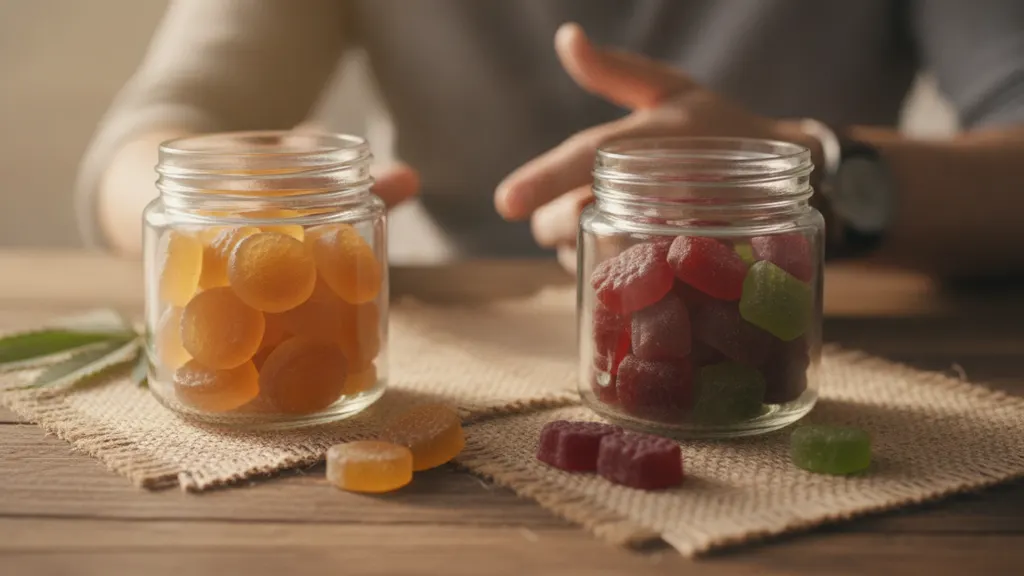
Common CBD-first scenarios include daytime use, sensitive users who dislike feeling altered, people mixing with prescription routines who need a lower-interaction profile, and buyers in states that restrict intoxicating hemp products. Our own breakdown of low-dose daytime strategies for focus covers the daytime side in more depth.
Common THC-first scenarios include sleep support, recreational evening use, and users seeking stronger perceived body effects. For sleep specifically, the head-to-head in CBD vs THC for sleep lays out where each cannabinoid tends to shine.
The entourage effect and why CBD vs THC gummies is not always either or
The framing of CBD vs THC gummies as a binary hides a middle option: full-spectrum. A full-spectrum hemp gummy contains CBD, trace delta-9 under the federal cap, and a set of minor cannabinoids and terpenes from the original plant. The entourage effect is the hypothesis that these components produce better outcomes together than alone.
The 2019 systematic review in the Journal of Clinical Medicine covering 72 studies reported that full-spectrum extracts containing both CBD and THC showed stronger outcomes in several domains than either compound in isolation. That does not mean full-spectrum is always the right pick, but it does mean an isolate is not automatically better because it is "pure."
If the entourage angle interests you, the deeper walk-through in full spectrum vs isolate hemp gummies compares each format head to head.
How the hemp-derived label applies to CBD vs THC gummies
Both categories rely on the same federal definition. Under the 2018 Farm Bill, as published on congress.gov, hemp is defined as cannabis containing no more than 0.3 percent delta-9-THC on a dry-weight basis. Anything above that threshold is federally scheduled cannabis, regardless of how it was farmed.
| Attribute | Hemp-derived CBD gummy | Hemp-derived delta-9 gummy |
|---|---|---|
| Primary cannabinoid | CBD | Delta-9-THC |
| Trace delta-9 possible | Yes, under 0.3% dry weight | Yes, formulated to stay under 0.3% dry weight |
| Intoxicating at typical serving | No | Yes at 2 to 10 mg per piece |
| Federal status | Legal under 2018 Farm Bill | Legal under 2018 Farm Bill |
| State status | Broadly legal | Varies, several states restrict |
That trace-THC allowance matters. It means a CBD-only gummy line can still contain measurable delta-9. It is usually far too little to feel, but it can register on sensitive drug screens.
What to look for on a COA when comparing CBD vs THC gummies
A COA is the batch-specific lab report from an accredited third party. It is the only place the CBD vs THC gummies difference becomes verifiable rather than promised. Skip the front label and open the PDF. The FDA has repeatedly warned that label claims and lab results do not always match.
Look for four things. First, cannabinoid breakdown in milligrams per piece, not just percent. Second, a clear delta-9-THC line that either sits under 0.3 percent by dry weight or lists a specific milligram value for a dosed gummy. Third, pass results for pesticides, heavy metals, and residual solvents within state and federal limits. Fourth, a batch or lot number that matches your jar.
If any of those four are missing, treat the product as unverified. Our step-by-step walk-through in how to read a hemp gummy COA shows what each column means using real report screenshots.
Matching CBD vs THC gummies to your actual goal
Edible cannabinoids reach peak blood concentration 90 to 120 minutes after ingestion, compared with 10 to 30 minutes for inhaled forms. That lag is the single reason most first-time buyers misjudge timing. Use that window to frame the CBD vs THC gummies match: write down what you want the gummy to do, then choose accordingly.
If the answer is "nothing dramatic, just take the edge off my day," a 10 to 25 mg CBD gummy is a low-risk starting point. If the answer is "wind down on Friday night after the kids are asleep," a 2 to 5 mg delta-9 gummy is the usual entry dose. If the answer is "help me stay steady through a long evening," a full-spectrum blend often lands better than either isolate.
Two rules apply regardless of which side of the CBD vs THC gummies split you land on. Start with a half serving. Wait the full 90 to 120 minutes before considering a second piece, since edibles peak much later than smoke or vapor. New buyers can pair this with the plain-English hemp gummy dosage guide for milligram-by-milligram footing.
Frequently asked questions
Will a CBD gummy get me high the way a THC gummy does?
No. CBD does not bind CB1 receptors the way delta-9-THC does, so a hemp-derived CBD gummy will not produce the intoxicating high people associate with cannabis. That is one of the clearest differences in this comparison. A CBD-only gummy may still contain trace delta-9 up to the 0.3 percent dry-weight cap set by the 2018 Farm Bill, but at that level a single serving is not intoxicating for most adults. See the foundational Russo 2015 review in Neurotherapeutics on receptor binding for the mechanism.
Which is better for beginners, CBD or THC gummies?
For most first-time buyers, a low-dose CBD gummy is the softer entry point because there is no intoxicating ceiling to worry about and side effects tend to be milder per the NCCIH consumer overview. If your goal is a mild recreational effect or evening wind-down, a very low-dose hemp-derived delta-9 gummy in the 2 to 5 mg range is the usual starter. That decision comes down to whether you want to feel a shift at all. Read a COA before your first gummy either way, and start with a half serving.
What is the entourage effect and does it really matter?
The entourage effect is the idea that cannabinoids and terpenes work better together than in isolation. A 2019 systematic review in the Journal of Clinical Medicine covering 72 studies reported that full-spectrum hemp extracts containing both CBD and THC showed stronger outcomes in several domains than either compound alone. It matters when you are choosing between a CBD isolate gummy and a full-spectrum hemp-derived gummy that includes trace THC and other minor cannabinoids. It matters less if you specifically want a THC-free product for personal or professional reasons.
Are both CBD and THC gummies federally legal if they are hemp-derived?
Under the 2018 Farm Bill, hemp-derived cannabinoids are federal legal as long as the finished product tests at or below 0.3 percent delta-9-THC by dry weight, per congress.gov. That covers both hemp-derived CBD gummies and hemp-derived delta-9 gummies that stay under the threshold. State law is where the picture splits: several states restrict or ban intoxicating hemp products even when they meet the federal definition. Check your state agriculture or health department page before ordering, and look for the exact delta-9 percentage on the COA.
How do I tell if a gummy is really CBD-dominant or THC-dominant from the label?
Ignore the front-of-pack marketing and read the cannabinoid table on the COA. A CBD-dominant gummy will list CBD in milligrams per piece well above the delta-9-THC line, often 10 to 25 mg CBD with under 0.3 mg THC. A THC-dominant hemp gummy flips that ratio, with 2 to 10 mg delta-9 per piece and either low CBD or none listed. The FDA has warned consumers that label claims and COA results do not always match, so choose brands that publish batch-specific lab reports.
Can I take a CBD gummy and a THC gummy at the same time?
Combining them is common and is part of the entourage effect logic covered in the 2019 Journal of Clinical Medicine review. Some users find that pairing a 10 to 25 mg CBD gummy with a low-dose delta-9 gummy softens the peak intensity of the THC while extending the in total effect window. Start low. Wait the full 90 to 120 minutes edibles need to peak before redosing. If you take prescription medication, check with a clinician first, since both cannabinoids can interact with the same liver enzymes used to metabolize many drugs.