
Will a THC gummies drug test catch you out at work? Yes - it can. Standard urine panels screen for the same cannabis metabolite whether the THC came from a marijuana joint or a hemp-derived gummy, and the legal hemp limit does nothing to lower your urine reading. If you have a screening on the calendar, here is what the test actually looks for and how long the metabolite stays detectable.
What a THC gummies drug test actually screens for
A standard 5-panel workplace urine screen does not look for THC itself. It looks for 11-nor-9-carboxy-THC, or THC-COOH, the inactive metabolite your liver creates after any cannabinoid exposure. The federal cutoff is 50 nanograms per millilitre. Cross that line on the immunoassay and the sample goes to confirmation, regardless of whether the source was a joint or a hemp-derived gummy.
Urine is the cheapest sample matrix and the one most employers, court systems, and insurance underwriters default to. Blood and saliva have shorter detection windows but are pricier and more invasive. Hair testing can reach back 90 days but is rarely used for routine workplace screening.
The two-step process matters. The first pass is an enzyme immunoassay (EIA) that flags samples at or above 50 ng/mL. Anything that fails goes to a second test on gas chromatography or liquid chromatography mass spectrometry (GC-MS or LC-MS), where the cutoff drops to 15 ng/mL for THC-COOH and the chemistry is far more selective. The Australian Standard AS/NZS 4308 sets the same two-step model for workplace urine collection - the official document index sits at the Standards Australia catalogue.
Here is the part most hemp gummy users miss: the metabolite the lab confirms does not distinguish source. THC-COOH is THC-COOH. Whether the molecule came from cannabis flower or a hemp-derived edible, the chromatogram looks the same. A positive THC gummies drug test result reads identically to a positive cannabis flower test, which is why product source documentation never overturns a confirmed reading. Our deeper note on hemp versus marijuana cannabinoid chemistry explains why source plant does not affect the metabolite signature.
How long hemp-derived THC stays in your system after a gummy
For an average adult who eats one 10 mg hemp-derived gummy with no prior cannabis exposure, THC-COOH typically clears in 3 to 7 days. For a daily user pushing 20 to 50 mg, the window stretches to 10 to 21 days. For chronic heavy users at 75+ mg daily, the metabolite can stay above the 50 ng/mL cutoff for 30 days or longer. Peer-reviewed clinical data from Huestis and colleagues at NIDA backs this range.
The reason is body fat. THC and its metabolites are fat-soluble. They store in adipose tissue and slowly leach back into the bloodstream over weeks. The more body fat you carry, the longer the tail. The leaner you are, the faster you clear - within reason.
Dose ladder examples from a 70 kg adult with average body fat:
| Use pattern | Typical dose | Detection window (urine) |
|---|---|---|
| One-off single gummy | 5 to 10 mg | 3 to 7 days |
| Occasional (1 to 2x weekly) | 10 to 20 mg | 5 to 10 days |
| Regular (3 to 5x weekly) | 20 to 50 mg | 10 to 21 days |
| Daily heavy | 75+ mg | 21 to 45+ days |
One trap to watch for - high-dose hemp-derived gummies are now widely available at 50, 100, even 250 mg per piece. At those doses you are effectively a daily heavy user after a single piece, and the timeline before any THC gummies drug test stretches well into the multi-week range. NIDA clinical pharmacology data on oral cannabinoid absorption at the NIDA drug information portal shows how dose-dependent onset makes serving-size accuracy matter - read the back of the pack before you assume one piece equals one dose.
If you want to read more on dose ladders for hemp products, our internal guide on hemp gummy dosage walks through milligram thresholds and onset timing.
Does the 0.3% delta-9 limit protect THC gummies drug test takers?
No. The 2018 Farm Bill defines hemp as cannabis containing 0.3% or less delta-9 THC by dry weight at harvest. That number applies to the plant material on the day it is tested by the farm. It is not a urine threshold. It is not a blood threshold. It does not tell your employer's lab anything about what is in your sample.
The math also runs against you. A 10 mg hemp-derived gummy is 10 milligrams of pure delta-9 THC by the time it reaches your liver. The 0.3% limit was never engineered to keep consumers below screening cutoffs - it was engineered to keep the crop legally classified as hemp instead of marijuana. Two different problems, two different regulatory framings.
This is the single most common misunderstanding I see from new customers. 'It is legal hemp, so the test should pass.' A THC gummies drug test does not care about the Farm Bill. It cares about THC-COOH concentration in your urine. Source legality and detection chemistry are independent variables. You can take a 100% federally legal hemp-derived gummy and fail a federal workplace test the next morning, with no legal recourse on the test result itself.
Australian readers face a comparable situation. Industrial hemp regulations let licensed growers cultivate low-THC cannabis, but workplace screening under AS/NZS 4308 is indifferent to crop source. The disconnect between product legality and workplace test outcomes is a global pattern documented in NIDA's workplace drug testing research at the NIDA research portal.
Personal factors that change THC gummies drug test clearance times
Body fat percentage alone can shift THC-COOH clearance from 4 days to 14 days on an identical 10 mg dose, according to NIDA adipose partitioning data. Five variables determine whether you pass or fail a THC gummies drug test: body fat, dose frequency, liver enzyme activity, hydration status, and exercise timing.
Body fat percentage. THC-COOH stores in fat. A lean person at 12% body fat will clear faster than someone at 32%, all else equal. Sudden rapid weight loss in the week before a screening can push stored metabolite back into circulation and produce a positive on a test that would have passed two weeks earlier.
Frequency of use. A single gummy taken once is a different problem than 10 mg nightly for six months. Repeat dosing saturates the fat tissue. Once saturated, clearance flattens to a long, slow tail. CSIRO analytical chemistry work on cannabinoid pharmacokinetics, summarised at the CSIRO research portal, confirms the saturation curve.
Metabolism and age. A 25-year-old with a fast resting metabolic rate clears differently than a 55-year-old. Liver enzyme activity (specifically CYP2C9 and CYP3A4) varies between individuals and slows with age.
Hydration. Water alone does not flush THC out faster, but acute over-hydration in the hours before a test can dilute creatinine below the lab's validity threshold, flagging the sample as adulterated. Labs reject and re-test. Drink normally, not strategically.
Method and frequency of exercise. Steady exercise across the weeks before a test helps. Heavy exercise in the 24 hours before a test mobilises stored fat - and the stored metabolites along with it - into the bloodstream. Stop intense training 48 hours before the screening. This pattern is documented in workplace testing reviews aggregated at the ACCC product safety hub for consumer health products.
Steps to take before a scheduled drug screening
For occasional users, 14 days of full abstention before a urine screen is typically sufficient to clear THC-COOH below the 50 ng/mL cutoff, per NIDA clearance-rate data. Daily users at 50 mg or more per day should plan a four-week minimum. Detoxes sold online - cranberry pills, masking drinks, niacin loading - do not work on GC-MS confirmation testing, and many trigger the dilution flag. Skip them.
Real steps that move the needle:
- Stop all hemp-derived THC products 14 to 30 days out. For occasional users, two weeks is usually enough. For daily users, plan four weeks. There is no shortcut.
- Confirm the lab uses GC-MS or LC-MS confirmation. A single-step immunoassay is more prone to false positives. Confirmation chemistry is selective and defensible.
- Drink water at normal levels. Aim for 2 to 3 litres a day across the week before, not a sprint in the morning of.
- Eat normally. Crash dieting in the week before mobilises stored THC-COOH. Eat the way you ate last month.
- Avoid intense exercise 48 hours before. Light walking is fine. Sprints, heavy lifting, and HIIT are not.
- Document your COA if asked. A confirmed positive cannot be overturned by paperwork, but if your employer's policy handles hemp-derived products differently from cannabis, the COA proves the source. Master Builders Australia's industry safety guidance covers documentation expectations at the MBA workplace safety library.
One more honest note - if your job is safety-sensitive (transport, construction, healthcare, defence), the rule in nearly every country is zero tolerance for THC metabolites regardless of legal hemp status. A positive THC gummies drug test in those roles can cost the job even when the product was lawfully purchased. Know your employer's policy before you order.
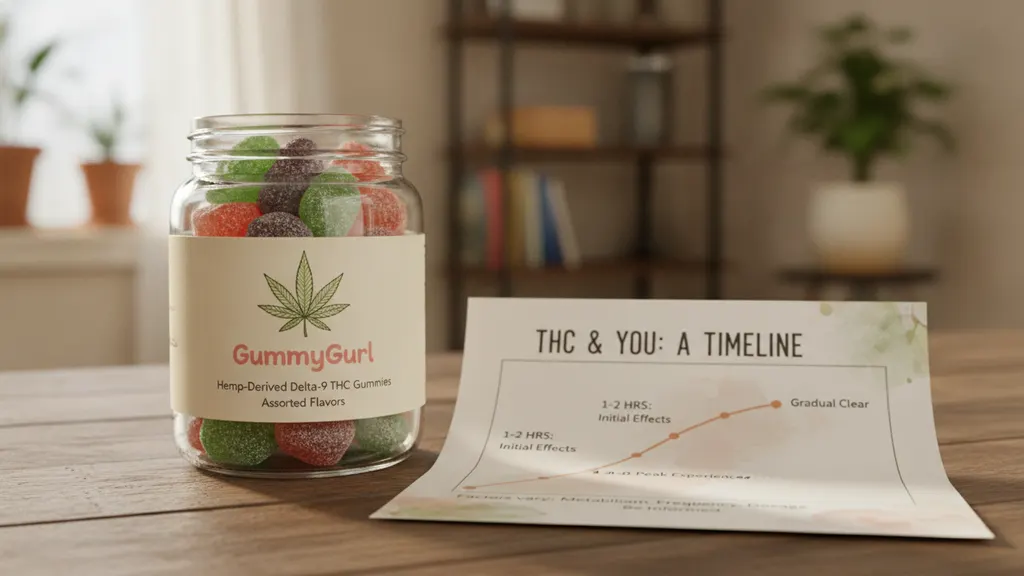
For batch-level documentation on every GummyGurl product, every gummy ships with a third-party COA verification guide that shows cannabinoid breakdown and pesticide screening.
Frequently asked questions
Can CBD-only gummies cause a positive THC test?
Pure CBD isolate gummies should not trigger a positive result, but most CBD gummies on the market are full-spectrum or broad-spectrum and contain trace THC under the 0.3% legal threshold. Trace THC adds up across daily dosing and can push metabolite levels above the 50 ng/mL cutoff over weeks of consistent use. A 2017 JAMA study of 84 CBD products found that 21% contained more THC than the label stated, meaning the dose you are actually taking can be three to five times higher than the label shows, particularly in oil-based formulations. If a screening is scheduled, switch to verified CBD isolate or stop dosing entirely 14 days before the test. Confirm the COA shows non-detectable delta-9 THC before assuming the product passes a THC gummies drug test.
How quickly does a single hemp-derived gummy trigger a THC gummies drug test positive?
THC-COOH appears in urine within 6 to 12 hours of ingestion and peaks around 24 to 72 hours after a single oral dose. The exact onset depends on whether the gummy was taken with food, your gastric emptying rate, and individual liver metabolism. An edible taken with a high-fat meal can delay peak absorption by 30 to 60 minutes, but the metabolite still enters urine within the same 6-to-12-hour window. A morning dose can show on an afternoon test the same day at low concentration. The honest answer for anyone with a same-day surprise screening is that yes, your gummy from breakfast can be detectable by lunch. Plan your abstention window around the THC gummies drug test format you face accordingly. Workplace screening references at Standards Australia's AS/NZS 4308 catalogue document the early detection rise curve.
Does the type of test matter - urine vs saliva vs hair?
Yes, the matrix changes everything. Urine tests screen for the THC-COOH metabolite and catch exposure for days to weeks. Saliva tests detect parent THC in oral fluid for 4 to 24 hours after ingestion, making them far more time-specific. Blood tests catch active THC in serum for 2 to 12 hours and are mostly used post-accident. Hair tests can reach back 90 days of historical use but are expensive and rarely used for routine workplace screening. CSIRO analytical chemistry summaries at the CSIRO research portal back these matrix-specific detection windows. If you know which test you are facing, plan around it. Saliva tests are common in roadside and pre-employment screening but will not flag a gummy you took five days ago.
Are any hemp-derived gummies actually drug-test safe?
Honestly, no - not if they contain measurable THC. The only product class that approaches test-safe is a verified broad-spectrum or isolate product with non-detect delta-9 on the COA, and even those can drift between production batches due to variation in the hemp source material. The most defensive move is to ask the brand for the specific lot COA, look for ND or less than LOQ next to delta-9 THC, and only dose products that show those values. A product marketed as THC-free that lacks a lot-level COA is an unknown risk. NIDA cannabinoid pharmacokinetics research at the NIDA research portal explains why batch-to-batch consistency matters - lot-level COAs are the practical filter most buyers should apply before dosing any hemp product.