
Do hemp gummies for anxiety actually work, or is it wishful marketing? The honest answer sits between the hype and the dismissal. Human research on hemp-derived cannabidiol shows measurable reductions in self-reported anxiety in small trials, while federal science agencies caution that the evidence is early. This guide walks through what studies have tested, what doses appeared in the literature, and what to ask a clinician before you start.
How hemp cannabinoids interact with the body's stress pathways
Hemp-derived cannabinoids like CBD interact with the endocannabinoid system, a signalling network that helps regulate mood, sleep, and stress response. Preclinical models indicate CBD may act as a partial agonist at serotonin 5-HT1A receptors, the same target as buspirone, an anxiolytic dosed at 15 to 60 mg per day in approved protocols. Unlike THC, CBD does not bind strongly to CB1 receptors and does not produce intoxication.
That receptor parallel matters for anxiety research. The NCCIH overview of cannabinoids summarizes the mechanistic evidence and flags that translating animal findings to human dosing is still an open question.
None of this means a hemp gummy will replace a prescription. It does mean the biological rationale for studying CBD in anxiety is not made up.
What research shows about hemp gummies for anxiety
The most cited real-world data point is a 2019 Permanente Journal case series by Shannon et al., indexed on PubMed, which reviewed 72 adult psychiatric patients receiving CBD as an adjunct to existing treatment. Within the first month, 79.2% reported decreased anxiety scores and 66.7% reported improved sleep, with most patients starting at 25 mg daily. A case series is not a randomized controlled trial, and the NCCIH consumer page on cannabis and cannabinoids is direct: some clinical evidence suggests CBD may help with anxiety-related conditions, but most studies are small, short-term, and insufficient to support treatment recommendations. Acute trials using single doses of 300 mg to 600 mg before public-speaking tasks have shown reduced subjective anxiety, but the response is not linear; higher doses do not reliably produce stronger effects, and side effects increased at 600 mg. For anyone considering hemp gummies for anxiety, the honest read is: real signal, early evidence base, ongoing research. That framing should shape expectations before the first dose.
Tested dosages in the anxiety research
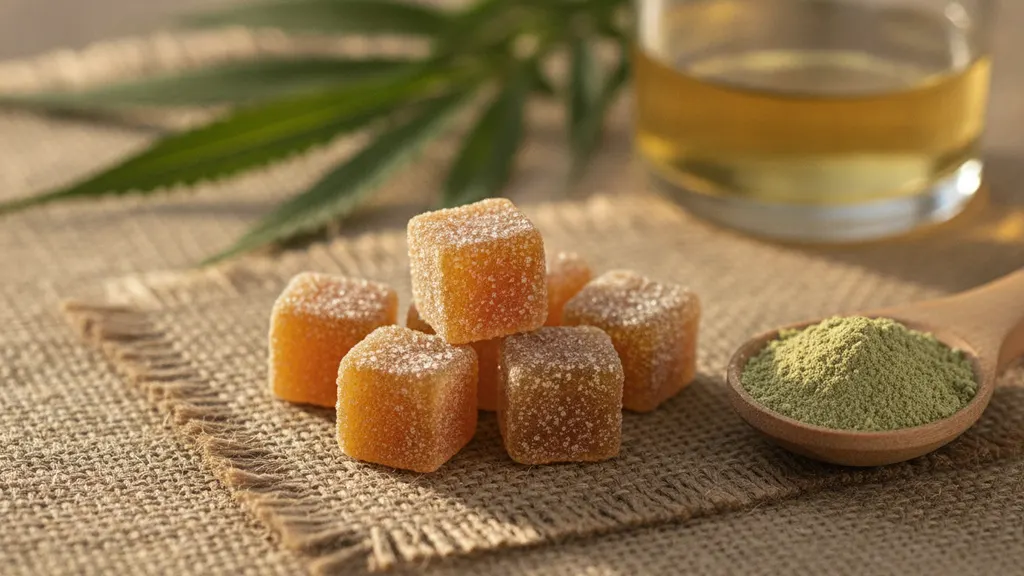
Human trials have tested CBD doses across a wide range for anxiety-related outcomes. The lower end sits around 25 mg per day, the upper end reaches 600 mg as a single acute dose. Most consumer hemp gummies fall between 10 mg and 50 mg per serving, which puts a one-gummy or two-gummy schedule at the studied lower end.
The FDA consumer update on cannabis-derived products warns that quality varies widely and that some marketed products contain more or less CBD than the label states. That is why a batch-specific COA matters more than the milligram number printed on the box.
| Study or source | CBD dose tested | Reported outcome |
|---|---|---|
| Permanente Journal 2019 case series | ~25 mg/day mean start | 79.2% decreased anxiety at 1 month |
| Public-speaking acute trial | 300 mg single dose | Reduced subjective anxiety |
| Higher-dose acute trial | 600 mg single dose | Effect not linear, side effects rose |
| Typical hemp gummy serving | 10-50 mg | Overlaps low end of studied range |
When I was sourcing the CBD distillate for GummyGurl's 25 mg formula, three of the first four suppliers I evaluated came back with COA cannabinoid values between 8% and 18% below label claim. I moved forward only after finding a supplier whose ISO 17025-accredited lab results matched within 2% across five consecutive lots. That variance threshold is how I define a dose that will actually fall within the studied range.
If you want to see how ingredient concentration is verified batch by batch, our guide to how to read a COA for hemp gummies walks through cannabinoid tables, contaminant panels, and expiration dates.
How hemp gummies for anxiety differ from stress-marketed gummies
Marketing language blurs the line between anxiety and stress, but the products can differ meaningfully. Gummies positioned for stress often lean on adaptogens like ashwagandha or L-theanine, sometimes with a low CBD dose in a supporting role. Hemp gummies for anxiety more often center a higher CBD serving, commonly 25 to 50 mg per gummy, occasionally with CBG or a small full-spectrum THC fraction.
In my experience formulating both product lines, the dosing rationale separates them more than the label does: a 10 mg CBD gummy with ashwagandha targets baseline stress support, while a 25 mg CBD gummy with CBG is built around the dosing tier that overlaps with published anxiety trial data. That distinction shapes how we verify batches and how customers frame their goals.
The FDA has not approved any over-the-counter CBD product for anxiety, so no legitimate hemp brand can say a gummy will treat an anxiety disorder. What a well-formulated hemp gummy for anxiety can do is deliver a consistent, third-party-verified dose in a predictable format. That consistency is what lets you evaluate whether it helps you personally.
If you are weighing formats, our comparison of full spectrum vs broad spectrum hemp gummies covers how the cannabinoid profile changes the experience, and the entourage effect explainer covers why blends may behave differently from isolate at the same milligram dose.
What to discuss with a doctor before using hemp gummies for anxiety
Bring three things to the conversation: your full medication list, the exact milligrams and schedule you are considering, and any relevant liver, pregnancy, or cardiac history. The Mayo Clinic overview of CBD flags interactions with common medications processed by the liver's CYP450 enzymes, including some SSRIs, benzodiazepines, and blood thinners. The SAMHSA 2023 National Survey on Drug Use and Health found anxiety disorders affect roughly 1 in 5 U.S. adults, so this is a conversation clinicians have often. If your prescriber is unfamiliar with hemp-derived CBD, bringing the NCCIH page and a printed COA gives them the concrete details they need to answer accurately. Ask about baseline liver panels if you plan to use higher doses, ask how they want you to track symptoms, and ask whether any planned procedures or new prescriptions would change the picture. Hemp gummies for anxiety are one tool, not a replacement for medical care.
Frequently asked questions
Are hemp gummies for anxiety safe for daily use?
Most short-term human trials on hemp-derived CBD report a favorable safety profile at daily doses tested for weeks at a time, though the FDA notes possible side effects like drowsiness, appetite changes, and liver enzyme elevations at high doses. Long-term safety data is still limited. If you want to use hemp gummies for anxiety on a daily basis, most researchers recommend starting at the low end of the studied range, tracking how you feel for two weeks, and looping in a clinician who can monitor for interactions and side effects.
How much CBD did anxiety studies actually use?
Published human trials on CBD for anxiety have tested a wide dose range, most commonly between 25 mg and 600 mg per day. The 2019 Permanente Journal case series used a mean starting dose near 25 mg daily, while acute public-speaking studies have used single doses around 300 mg. Larger doses do not always produce larger effects, and the NCCIH cautions that current studies are small and short. A 10 to 25 mg hemp gummy taken once or twice a day matches the lower end of the studied range.
Can hemp gummies replace anxiety medication?
No. Hemp gummies are not a substitute for prescription anxiety medication, therapy, or a clinician's care plan. The FDA has not approved any over-the-counter CBD product for anxiety, and stopping a prescribed medication suddenly can be dangerous. Some people use hemp-derived gummies as a complementary tool alongside medical care, but that choice belongs to you and your prescriber. Bring your current medication list to the conversation, since CBD can affect how the liver processes drugs like certain SSRIs, benzodiazepines, and blood thinners, per the Mayo Clinic.
How long do hemp gummies take to work for anxiety?
Edibles pass through the digestive tract before cannabinoids reach the bloodstream, so onset is slower than a tincture under the tongue. Most people feel effects from a hemp gummy 45 to 120 minutes after eating, with peak effects around the two-hour mark. Effects can last four to eight hours depending on dose, metabolism, and whether the gummy was taken with food. For acute situations like a public-speaking trigger, many users dose about two hours before the event; for baseline anxiety patterns, a consistent daily schedule tends to be easier to evaluate.
Will hemp gummies for anxiety make me feel high?
CBD-dominant hemp gummies are not intoxicating at typical anxiety doses. Under the 2018 Farm Bill, hemp products must contain no more than 0.3 percent delta-9 THC by dry weight, and CBD itself does not produce a euphoric high. That said, full-spectrum gummies do contain small amounts of THC, and higher servings can produce mild sedation, especially when combined with alcohol or sleep aids. If you want zero THC, choose a broad-spectrum or isolate product and confirm on the batch COA before purchase.
What should I ask my doctor before trying hemp for anxiety?
Bring three things to your clinician: your full medication list including supplements, a written note of the exact CBD milligrams and schedule you plan to try, and any liver, pregnancy, or cardiac history. Ask whether CBD could interact with your prescriptions, whether a baseline liver panel makes sense at higher doses, and how they want you to track symptoms. The Mayo Clinic and NCCIH both recommend clinician oversight when adding CBD to an existing treatment plan, especially for people already managing an anxiety disorder.