
What are you actually paying extra for when you buy live resin hemp gummies instead of a plain distillate pack? The short answer is chemistry preserved by cold. Live resin starts with fresh plants that were frozen within hours of harvest, which locks in terpenes and minor cannabinoids that ordinary drying would burn off. Whether that translates into a better experience for you comes down to what your COA shows and how your body responds.
What sets live resin gummies apart from distillate
Live resin hemp gummies are edibles made with a hydrocarbon extract from hemp plants that were flash-frozen immediately after cutting, rather than dried and cured. That single processing choice reshapes the chemistry of the final gummy. Terpenes and volatile minor cannabinoids that would evaporate during a two-week cure survive the trip into the batch tank.
Standard distillate takes the opposite path. Dried, cured biomass runs through ethanol or CO2 extraction, then a wiped-film distillation stage that isolates a single cannabinoid, typically delta-9, delta-8, or CBD, at 90 percent or higher purity. The result is a colorless, nearly odorless oil. It doses cleanly, but the aromatic personality of the plant is gone. Fresh terpenes can be added back before infusion, but they arrive from a bottle, not from the flower that grew the cannabinoids in the first place.
The USDA hemp program does not care which method you use. Under Public Law 115-334, any finished hemp product is legal at the federal level as long as it stays under 0.3 percent delta-9 THC by dry weight. Live resin and distillate get the same yardstick. What differs is what else rides along for the trip.
Why cold extraction preserves terpene character
The case for live resin rests on temperature. Monoterpenes like myrcene, limonene, and pinene start evaporating at temperatures below 70 degrees Fahrenheit. A hemp plant hung to dry in a warm barn loses a large share of those compounds before it ever reaches an extractor. Freezing the plant to below negative 20 degrees Celsius within hours of harvest halts that loss.
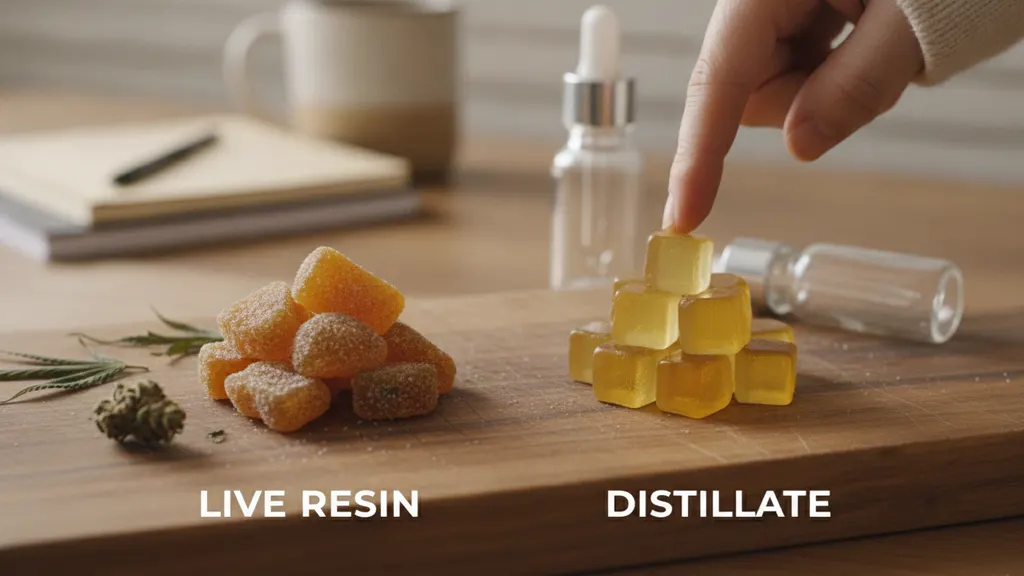
Once the frozen material hits a closed-loop hydrocarbon system, usually butane or propane, the solvent pulls terpenes, cannabinoids, and plant lipids out together. The extract is then purged of solvent under vacuum at low temperature. The end product is a sticky, aromatic resin that reads like the plant it came from. When infused into a gummy at the emulsification step, that aromatic profile carries through to the finished piece.
Terpene retention differences between flash-frozen and conventionally dried cannabis biomass are documented in extraction research, including Ross and ElSohly's comparison of fresh and air-dried bud volatile oil profiles published in the Journal of Natural Products.
Distillate loses that character by design. The distillation step boils off terpenes long before the finished oil is bottled. Any aroma you smell in a distillate-based gummy came from a botanical or cannabis-derived terpene blend added after the fact. That is not necessarily worse, and reputable brands can produce excellent reintroduced-terpene products. It is simply not the same molecule you would meet in a live extract. For a deeper dive on the aromatic side of hemp, see our post on terpenes in hemp gummies and why they matter.
Does the entourage effect deliver a fuller experience
The entourage effect is the hypothesis that cannabinoids and terpenes work better together than any single molecule works alone. It is the mechanism most often cited to justify a premium price on full spectrum live resin hemp gummies. The evidence base is mixed and still developing.
Peer-reviewed work indexed in PubMed supports the idea that certain terpene and cannabinoid combinations produce measurable modulation in cell and animal models. Russo's 2011 review in the British Journal of Pharmacology, examining phytocannabinoid-terpenoid interactions across plant aromatic compounds, is among the most frequently cited papers in this area. MacCallum and Russo's 2018 paper in the European Journal of Internal Medicine on practical cannabis administration observed that patients using whole-plant preparations reported different dosing thresholds and response profiles than those relying on isolated cannabinoids, a finding consistent with synergistic activity between the plant's aromatic and cannabinoid fractions. The NCCIH overview on cannabis and cannabinoids is careful to note that whole-plant preparations may behave differently from isolated cannabinoids, but firm conclusions require larger randomized controlled trials with standardized dosing.
What that means practically: some users report that a 10 mg live resin gummy feels rounder, more balanced, or more relaxing than a 10 mg distillate gummy at the same THC dose. Others notice nothing at all. Body chemistry, tolerance, and expectation all play a role. The honest position is that live resin may offer a fuller experience for a subset of users, and that neither the FDA nor any regulator has certified the entourage effect as clinical fact.
There is a full breakdown of this topic in Entourage effect hemp gummies: why cannabinoid blends may work better.
How to read a COA and spot a genuine live resin product
The label on the front of the bag is not evidence. The certificate of analysis is. A brand making genuine live resin hemp gummies will link its COA directly from the product page, and that COA should come from an accredited laboratory following FDA-recognized testing practices. The industry standard is ISO/IEC 17025 accreditation, and most state hemp programs require it for compliance testing.
ISO/IEC 17025 laboratory accreditation is the technical foundation that makes a hemp COA trustworthy. Labs certified under that international standard undergo regular third-party audits, run blind proficiency tests with samples of known composition, maintain documented chain of custody from sample intake to result delivery, and calculate and report measurement uncertainty alongside every figure they publish. That uncertainty value matters: it tells you the error margin on the potency number, so a result of 0.25 percent delta-9 THC with a plus or minus 0.03 percent uncertainty is meaningfully different from an identical number printed without any uncertainty data at all. When a brand's COA comes from an accredited lab, those technical safeguards have already been independently verified. When a brand links to a COA from an unaccredited testing service, or does not publish a COA at all, there is no external check on the accuracy of the numbers. For live resin hemp gummies, where the claimed terpene profile is part of the product's value, accreditation is not a technicality but the primary mechanism that separates a credible claim from an unverifiable marketing statement.
Two panels matter. The cannabinoid potency panel confirms the milligrams of delta-9 THC per gummy, plus any minor cannabinoids like CBD, CBG, CBC, CBN, and THCV. The terpene panel measures the concentration of aromatic compounds, usually reported as percentages of the extract. A real live resin extract will show at least half a dozen terpenes above the lab's limit of quantification. A distillate-based product will typically list zero terpenes, or a suspiciously round profile that suggests reintroduction from a bottle. If you have never opened a hemp COA before, our walkthrough on how to read a COA for hemp gummies covers each section in plain English.
Live resin hemp gummies vs distillate at a glance
If you strip away the marketing, the choice between live resin and distillate is a set of tradeoffs. This table summarizes what each format is honestly good at, so you can pick based on your priorities rather than the shiniest bag.
| Attribute | Live resin gummies | Distillate gummies |
|---|---|---|
| Starting material | Flash-frozen fresh hemp | Dried, cured hemp |
| Terpene content | Preserved from plant | Stripped, sometimes re-added |
| Minor cannabinoids | Naturally present | Often removed |
| Delta-9 THC ceiling | 0.3% by dry weight | 0.3% by dry weight |
| Typical retail premium | 20 to 40 percent higher | Baseline |
| COA expectation | Cannabinoid + terpene panels | Cannabinoid panel only |
For related reading on how the extraction category shapes the finished piece, see our comparison of full spectrum vs isolate hemp gummies.
Are live resin hemp gummies worth the higher price
Price varies by brand, dose, and pack size, but the pattern is consistent. Live resin hemp gummies typically retail at a 20 to 40 percent premium over comparable distillate products from the same maker. The cost stack is real: hydrocarbon extraction gear, cold-chain handling from harvest through purge, terpene testing on every batch, and slower production throughput. None of that is inflated margin. Whether it is worth it for you depends on what you are chasing.
If you want a predictable, low-cost per milligram edible for casual use, well-made distillate is a rational buy. If you value the closest approximation to fresh-flower chemistry in a shelf-stable gummy, live resin is the format that gets you there. If you fall somewhere in between, a low-dose pack of each from a brand with published COAs is the cheapest way to run the experiment on yourself.
Frequently asked questions
Are live resin hemp gummies stronger than distillate gummies?
Not by milligram of THC alone. A 10 mg distillate gummy and a 10 mg live resin gummy hit the same delta-9 ceiling set by the 2018 Farm Bill. What people usually mean by stronger is character: live resin keeps volatile terpenes and minor cannabinoids that distillate strips out during winterization. Some users report a fuller, rounder feel from the same dose. Others notice nothing. The FDA has not endorsed the entourage effect as proven, so shop the COA, not the marketing.
How can I tell if a gummy is really live resin?
Look for two things on the certificate of analysis. First, a terpene panel with measurable percentages of myrcene, limonene, beta-caryophyllene and pinene. A true live resin extract will show at least a handful of terpenes above the lab's limit of quantification. Second, a full cannabinoid profile listing minor cannabinoids like CBG, CBC and CBN alongside the major ones. Distillate COAs typically show one or two cannabinoids and no terpene panel at all. If the brand cannot produce both panels from an accredited lab following FDA testing guidance, treat the live resin label as marketing.
Do these gummies contain more THC than federal law allows?
No. USDA hemp regulations under Public Law 115-334 set a 0.3 percent delta-9 THC ceiling by dry weight, and that limit applies to any finished hemp product regardless of extraction method. Live resin and distillate gummies are held to the same rule. A compliant live resin gummy shows delta-9 THC well under that threshold on its COA. If a product exceeds it, it is not federally legal hemp, regardless of what the label says.
Why do live resin hemp gummies cost more?
The math starts at harvest. Fresh plants must be flash-frozen within hours of cutting, then held at sub-zero temperatures through hydrocarbon extraction. That means specialized freezers, closed-loop butane or propane systems, and slower throughput per shift. Distillate runs on dried biomass at ambient temperature, so extractors process more pounds per shift with cheaper equipment. Add a terpene panel to every batch COA and the per-gummy cost climbs another few cents. Consumers usually pay a 20 to 40 percent premium at retail, per USDA hemp market data.
Will hemp-derived edibles show up on a drug test?
Yes, they can. Standard workplace urine tests screen for THC metabolites, and any hemp-derived edible with detectable THC can trigger a positive result if consumed regularly or in higher doses. Live resin and distillate gummies both carry that risk. The extraction method does not change the THC that reaches your bloodstream, per SAMHSA workplace drug testing guidance. If you are subject to testing, read our full write-up on hemp gummies and drug tests before you buy.
Are live resin hemp gummies worth the price for most buyers?
It depends on what you value. If you care about the fullest possible cannabinoid and terpene profile in a shelf-stable edible, live resin hemp gummies are the closest you can get to fresh-flower chemistry in a packaged product. If you want a predictable dose at the lowest cost per milligram, well-made distillate is a rational pick. The gap in reported experience is real for some users and negligible for others. Try a low-dose pack of each from a brand with published COAs, per NCCIH consumer guidance, and let your own body be the judge.