
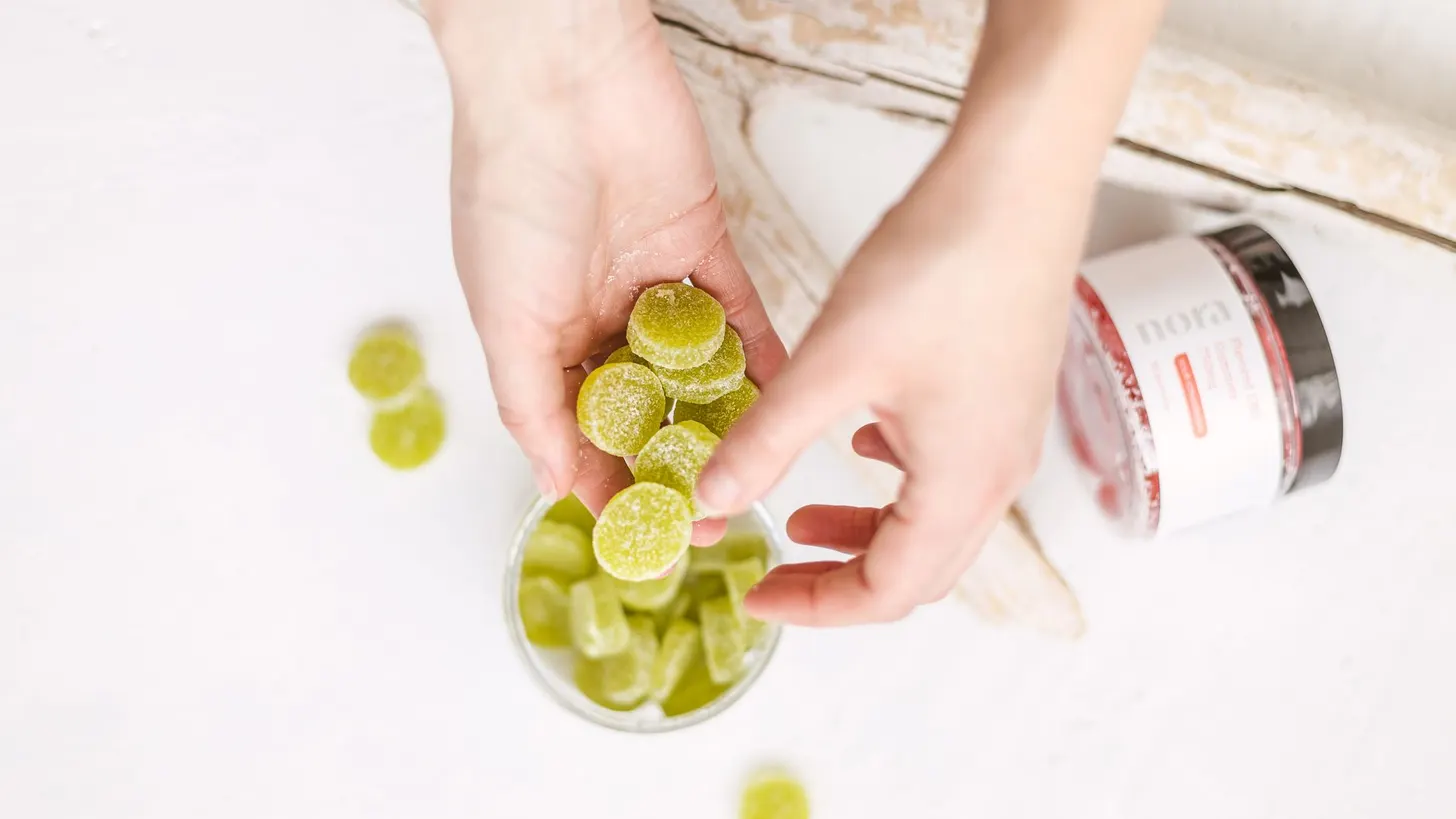
"How many milligrams should I actually start with?" That is the question hemp customers send me most often, and the answer is not on the back of the package. A real hemp gummy dosage guide depends on your weight, your tolerance, what you ate today, and whether you have ever tried a hemp-derived edible before. The honest starting point for most first-timers sits between 2.5 mg and 5 mg, taken with food, and re-evaluated only after two full hours.
Why this hemp gummy dosage guide can't promise one universal number
There is no single milligram number that works for every adult body, and any hemp gummy dosage guide that promises one is overselling. The federal government has not set a standardized hemp edible serving, brands write their own labels, and the same 10 mg gummy will land differently in two people sitting on the same couch.
I launched GummyGurl in Charlotte, North Carolina in 2019, partly because I got my own first hemp edible completely wrong. I took half of a 25 mg gummy at 7 p.m., felt nothing by 8:30 p.m., and took the second half before the first dose peaked. By 10 p.m. both were active at once and the experience was overwhelming. Every COA we post at GummyGurl, and every guide like this one, exists because that gap between the number on the label and the experience in your body is real, and it catches first-time buyers who trust a milligram count without knowing what shapes how it actually lands. That experience also pushed me to join the National Cannabis Industry Association in 2020, where staying current on hemp testing standards and federal guidance is part of the membership culture.
Onset also depends on what you ate that morning, how much you slept, your baseline tolerance, and whether you took anything else in the prior six hours. According to the FDA's hemp-derived CBD FAQ, no recommended daily dose has been established for CBD or hemp-derived THC products. That puts the burden on the buyer to read labels carefully, ask brands for a certificate of analysis, and start at a serving small enough to learn from. A certificate of analysis is a document issued by an ISO 17025-accredited third-party lab confirming cannabinoid content, residual solvents, pesticides, and heavy metals for a specific production batch. If you want a deeper dive on milligram-by-milligram beginner protocols, our beginner mg guide walks through the trade-offs without overpromising. Read the rest of this hemp gummy dosage guide before you settle on any labelled jar.
What low, mid, and high-dose hemp gummies typically contain
This hemp gummy dosage guide breaks the market into three rough tiers. Low-dose hemp-derived gummies generally hold 2.5 mg to 5 mg of THC or CBD per piece; our GummyGurl low-dose gummies sit in this bracket and are the starting point I suggest for most first-time customers before they consider stepping up. Mid-dose products land at 10 mg to 15 mg. High-dose labels often begin at 25 mg and stretch as far as 100 mg per gummy.
The wide band at the top matters most. A 25 mg gummy and a 100 mg gummy share the same shelf description but deliver four times the dose. A 2021 Frontiers in Pharmacology review of cannabinoid pharmacokinetics documented wide inter-individual variability in blood levels after identical oral doses, which is exactly why 'high-dose' cannot be read as a single experience. Always rotate to the per-gummy milligram count on the lab certificate before deciding whether the jar in your hand counts as gentle, moderate, or strong for you.
How body weight, tolerance, and metabolism affect your hemp gummy dosage guide starting point
Body weight is the first knob most people reach for, but it is not the most reliable one. The same 2021 review found that BMI alone failed to predict cannabinoid blood concentrations, with food intake, recent use, and CYP450 liver enzyme activity exerting a larger effect on how a gummy lands.
Anyone taking medications metabolised through CYP3A4 or CYP2C9 should speak with a prescriber before adding hemp-derived edibles. CYP3A4 processes a wide category of drugs including many statins, certain calcium channel blockers, and some antifungals; CYP2C9 handles warfarin and several common anti-inflammatory drugs. When a cannabinoid competes for the same enzyme pathway, the co-administered drug can accumulate to blood levels the prescribing doctor did not anticipate. The 2021 Frontiers in Pharmacology review documented inter-individual variability in oral cannabinoid blood concentrations that differed by a factor of three or more between participants at comparable body weights, with CYP enzyme activity and recent food intake cited as primary drivers of that spread.
Research cited by the National Cancer Institute's cannabis pharmacology summary shows oral delta-9-THC bioavailability typically falls between 4 and 20 percent under fasted conditions, with food intake raising that ceiling. Two people who take an identical 10 mg gummy at the same time can end up with meaningfully different amounts in their bloodstream based solely on what they ate beforehand. Practical translation: a 200-pound first-timer who skipped breakfast may feel a 10 mg gummy harder than a 130-pound daily user who ate a full meal an hour earlier. A sensible hemp gummy dosage guide treats weight as one input among several, never the only one. If you use hemp gummies often and notice your serving creeping up, our piece on resetting THC tolerance covers what a 7- to 21-day break actually does to your response curve.
What 'start low, go slow' looks like in practice
'Start low, go slow' is more than a slogan. It is a measurable titration protocol echoed by the National Center for Complementary and Integrative Health for cannabis edibles: pick the lowest reasonable serving, wait two full hours for onset and peak, and only then decide whether to redose.
Applying this hemp gummy dosage guide to a real two-week protocol looks like the table below, and the curve underneath shows exactly when redosing tends to backfire.
| Day | Serving | Notes |
|---|---|---|
| 1-3 | 2.5 mg | Take with food, evening, no driving. |
| 4-7 | 5 mg | If day 1 felt nothing, step up by 2.5 mg. |
| 8-11 | 7.5 mg | Note onset time and peak intensity. |
| 12-14 | 10 mg | Hold here for a week before any further increase. |
The curve below shows why patience matters: edibles barely register in the first 30 minutes, climb sharply between 60 and 120 minutes, and only begin tapering after the two-hour mark. The most common over-consumption mistake is taking a second gummy at the 45-minute point because nothing seems to be happening yet.
For exact timing of onset and offset, our breakdown of how long THC gummies take to work explains why a full meal can delay peak by 45 minutes or more, and why an empty stomach can produce a sharper, shorter curve that surprises new users.
When to split a gummy or move tiers in this hemp gummy dosage guide
If a labelled 10 mg gummy still feels too strong at the 90-minute mark, splitting it in half is a fair move. Cut on a clean board, keep the other half wrapped for next time, and recheck the COA so you know what 5 mg of that batch actually contains.
The same logic runs in reverse: if 5 mg has stopped landing after weeks of nightly use, that is a signal to either take a tolerance break or step up tiers, not to double the serving on a whim. The CDC's marijuana health effects briefing emphasizes that delayed-onset edibles cause the most accidental over-consumption, with users redosing before the first gummy peaks. A patient hemp gummy dosage guide always favours waiting over guessing. Before changing tiers, learn to read your lab paperwork. Our COA reading guide covers what total THC versus delta-9 THC actually mean on the document, and why a 'high-dose' jar from one brand can hold less active cannabinoid than a 'mid-dose' jar from another brand once you read the fine print.
Frequently asked questions
Hemp gummy dosage guide: how many mg for a first-time buyer?
Most beginners do well starting at 2.5 mg to 5 mg of THC or CBD per serving, taken with food in the evening. The FDA has not standardized a recommended dose, so this range comes from industry convention rather than regulation. Any hemp gummy dosage guide worth following will tell you to read the certificate of analysis, confirm what one labelled gummy actually contains, and decide whether to take a whole one or split it. Wait at least two full hours before considering a top-up dose so you do not stack effects accidentally.
How long until a hemp gummy starts working?
Oral hemp-derived gummies usually begin to take effect between 30 and 90 minutes after ingestion, with peak intensity arriving around 60 to 180 minutes. According to the CDC, that delayed onset is the biggest reason new users accidentally over-consume: they assume the first dose did nothing and take a second before the first peaks. Stomach contents, body composition, and metabolism all push the curve. Plan a quiet evening, avoid driving, and do not commit to a second gummy until the two-hour mark has fully passed.
Does body weight determine the right hemp gummy dose?
Body weight is only one factor. A 2021 Frontiers in Pharmacology review of cannabinoid pharmacokinetics found high inter-individual variability after identical oral doses, with food intake and liver enzyme activity often outweighing weight differences. A heavier person can feel a 5 mg gummy strongly, and a lighter person can sometimes tolerate 10 mg with no trouble. Use weight as a soft input alongside tolerance history, recent eating, and what you actually plan to do that evening, never as the sole knob to turn for your serving size.
What counts as a high-dose hemp gummy?
In the hemp-derived market, products labelled high-dose typically start at 25 mg and can reach 100 mg of THC or CBD per gummy. That four-fold range matters because a 25 mg gummy and a 100 mg gummy share a shelf descriptor but deliver very different experiences. The FDA hemp-derived CBD FAQ confirms there is no federal standard for serving size. Use this hemp gummy dosage guide as a starting frame, but always verify the per-gummy milligram count on the COA before assuming the front-of-package wording matches what you wanted.
Can you split a hemp gummy in half safely?
Splitting a hemp-derived gummy is one of the simplest titration moves. Cut on a clean cutting board with a sharp knife, store the unused half wrapped at room temperature, and use it within a few days. Half of a labelled 10 mg gummy is not always exactly 5 mg because cannabinoids may not distribute perfectly evenly across the candy matrix. A 2023 Molecules review of cannabinoid safety and efficacy notes that the same dose of cannabis may affect individuals differently depending on genetics, food intake, and enzyme activity. For a more precise low dose, buying a product labelled 2.5 mg or 5 mg from the start is usually the cleaner choice.
How do I know if a hemp gummy is third-party tested?
Look for a Certificate of Analysis issued by an ISO 17025-accredited lab, dated within the past 12 months, and matched to the batch number printed on your jar. A trustworthy COA reports total THC, total CBD, minor cannabinoids, residual solvents, pesticides, and heavy metals. The USDA hemp program mandates third-party testing for licensed growers, but downstream gummy makers are not subject to identical federal rules, so verifying the COA at the brand level is on you as the buyer, every batch.