
What changes on November 12? The 2026 hemp ban explained in one paragraph: a Farm Bill amendment redefines federal hemp to exclude consumable products carrying quantifiable THC above 0.4mg per package. Raw hemp fiber and pure CBD stay legal. Gummies, vapes, and beverages with delta-8, delta-9, or delta-10 in measurable amounts move into a stricter category unless reformulated. This guide walks through the new rule and what it means for the shelves you shop.
The 2026 hemp ban explained in plain English
The 2026 hemp ban explained in plain English starts with one bill number: HR 8467. Congress passed the amendment in summer 2026 to modify the definition of hemp in 7 U.S.C. § 1639o. The 2018 Farm Bill old test, 0.3% delta-9 THC by dry weight, still applies to raw plant material. The amendment adds a second test for finished consumable products: any quantifiable THC above 0.4mg per package places the product outside the federal hemp definition. The full amendment text on Congress.gov lays out the language. The reason Congress acted: the 2018 Farm Bill, written before the rise of delta-8 and high-dose hemp-derived edibles, did not anticipate that a 0.3% by-weight test on raw biomass could yield finished products with 50mg or 100mg of intoxicating compounds per gummy. The new ceiling closes that gap.
The amendment does not touch the regulatory framework for raw fiber, hemp seed, or industrial CBD isolate production. Farmers growing hemp under the USDA Domestic Hemp Production Program can continue under the same license process. Lab testing rules for biomass remain identical. The change concentrates entirely on what reaches a consumer in a gummy, drink, or vape pack.
Timeline of the 2026 hemp ban explained step by step
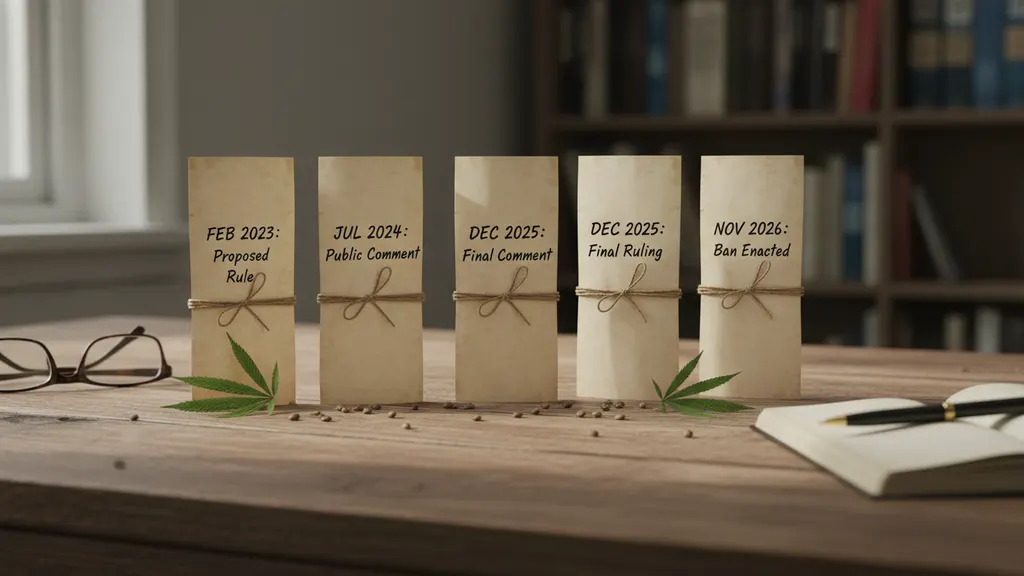
The timeline of the 2026 hemp ban explained step by step covers eight months from introduction to enforcement. The Miller-Mast amendment was first attached to the Farm Bill draft in March 2026. The House Agriculture Committee marked it up in April and the full House passed the bill in June. The Senate cleared the package through reconciliation in August. The President signed the bill into law on September 12, 2026. The text included a 60-day grace period, setting the federal enforcement date at November 12, 2026.
The grace period lets manufacturers sell through legacy inventory and gives retailers time to pull non-compliant stock. The DEA scheduling guidance issued on October 15 confirmed that products outside the new hemp definition will be handled as controlled substances at the federal level after the cutoff. State enforcement varies, as detailed further down.
What the 2026 hemp ban explained means for shoppers
What the 2026 hemp ban explained means for shoppers comes down to product type and total THC per package. Pure CBD isolate products are unchanged. Hemp seed oil is unchanged. Topicals are unchanged. The shelves that will look different are the ones carrying delta-8, delta-10, HHC, THC-A flower, and high-dose delta-9 gummies. After November 12, those products either reformulate to fit the 0.4mg ceiling, move to state-licensed cannabis dispensaries where one exists, or disappear from the legal market.
The 2026 hemp ban explained for a typical shopper looks like this: if you bought a CBD tincture last year for general comfort, you can keep buying the same tincture. If you bought a 25mg delta-8 gummy at a gas station, that gummy is no longer federally compliant. If you bought a hemp-derived seltzer with 5mg delta-9 per can, the manufacturer must either drop the dose under the package limit or move distribution into a state-licensed cannabis channel. The FDA standing position on hemp-derived cannabinoids continues to apply to the CBD side of the market.
Which hemp-derived products stay legal after November 12
This is the table to keep open in a browser tab on November 12. The rule is straightforward at the federal level: zero quantifiable THC, or total THC at or under 0.4mg per finished package, equals federally legal hemp. Anything over that threshold drops out of the hemp category and becomes a state-cannabis question instead. The state policy tracker at NCSL shows which states have parallel rules and which rely on federal law.
| Product type | Federal status after Nov 12 | What to check |
|---|---|---|
| CBD isolate gummy (0mg THC) | Legal | COA showing non-detect THC |
| Hemp seed oil (food grade) | Legal | USDA Organic seal optional |
| Hemp topical (cream, balm) | Legal | Total THC under 0.4mg per package |
| Full-spectrum gummy under 0.4mg total THC | Legal | Batch COA per package |
| Delta-8 gummy (quantifiable dose) | Restricted | State-licensed cannabis channel |
| HHC vape | Restricted | State-licensed cannabis channel |
| THC-A flower | Restricted | State-licensed cannabis channel |
| 5mg delta-9 hemp seltzer | Restricted | Reformulate or move channel |
The 0.4mg ceiling refers to total THC across all isomers measured in the finished product, calculated per saleable package, not per serving. A 20-count gummy bag must total under 0.4mg, which generally means each gummy carries near-zero quantifiable THC. Anchor product labels to a batch COA you can read before purchase.

State-by-state response to the 2026 hemp ban explained
State response to the 2026 hemp ban explained tracks three patterns. The first pattern: 23 states already passed their own intoxicating hemp restrictions before federal action, so the November 12 change matches what those state laws already require. The second pattern: states with active cannabis dispensary systems are moving high-dose hemp products into the dispensary channel. The third pattern: a smaller group of states is challenging the federal change in court or carving out lower-THC craft beverage exemptions through state legislation.
Texas tightened delta-8 rules through the Department of State Health Services consumable hemp program in 2024, and California codified its own intoxicating hemp ban via AB 2223, available on the California legislature bill page. Florida moved the same direction through the FDACS consumable hemp program. State-level rules generally stack with the federal floor: where state law is stricter, state law wins. A shopper in a strict state already saw most of these changes hit shelves between 2023 and 2025.
We cover the details separately in Can you fly with hemp gummies? TSA rules and state laws 2026.
What to do before the November 12 deadline
Three steps cover the practical side of the 2026 hemp ban explained for someone who buys hemp-derived products regularly. First, read the COA. Every reputable hemp-derived gummy maker publishes a batch certificate of analysis showing total THC content per package. If a product page has no COA link, consider that a red flag well before any deadline. Second, check the brand reformulation statement. Brands that are continuing past November 12 are publishing public notes about which SKUs change and which stay the same. Brands that go silent on the question are usually clearing inventory. Third, check your state rules through the CDC state cannabis law reference, since your state may already have stricter limits.
If you buy hemp-derived products for sleep, comfort, or general wellbeing, the post-November shelf will still include CBD isolates, hemp seed oil, broad-spectrum CBD with non-detect THC, and topicals. The category most affected is the intoxicating hemp side: delta-8 gummies, THC-A flower, HHC vapes, and high-dose delta-9 beverages. If those are part of your routine, plan accordingly. For deeper background, see the difference between CBD and THC and our state hemp law overview for 2026.
Frequently asked questions
Does the 2026 hemp ban make all CBD illegal?
No. The amendment specifically targets consumable hemp-derived products with quantifiable THC above 0.4mg per finished package. CBD isolate gummies, CBD tinctures with non-detect THC, CBD topicals, and hemp seed oil products remain federally legal after November 12, 2026. The 2018 Farm Bill framework for hemp cultivation and processing stays in place. If you currently buy CBD-only products with COAs showing zero detectable THC, your product type is unaffected. The change is concentrated on the intoxicating hemp category that grew out of the 2018 Farm Bill per-weight test, not the non-intoxicating CBD market that the FDA consumer update on cannabis products continues to oversee.
What happens to hemp products I already own on November 12?
Personal possession of products purchased legally before November 12, 2026 is not addressed in the federal amendment, which focuses on manufacturing and sale. State law controls personal possession, so the answer depends on where you live. In a state that already aligned with the federal threshold, your existing products were probably already non-compliant before the federal change. In a state without parallel restrictions, possession of products bought during the legal window typically remains a low priority for enforcement, though state authorities can update their position. The NCSL state marijuana laws map is the cleanest reference for your specific state.
Will my state ban hemp-derived products too?
That depends. Twenty-three states had already passed their own intoxicating hemp restrictions by October 2025, eleven states are routing high-dose hemp products through their cannabis dispensary systems, and sixteen states default to federal law and will follow the November 12 amendment automatically. A handful of states are pursuing legal challenges or carving out specific exemptions for low-dose hemp beverages. Texas, California, and Florida have already published consumer guidance through their respective health departments. The FDACS Florida consumer hemp page shows how a state agency publishes its rules to the public.
Are GummyGurl hemp-derived products still legal after November 12?
The GummyGurl line was reformulated in Q1 2026 to align with the proposed federal threshold, with batch COAs published on every product page showing total THC content per package. Customers can read the COA before purchase, which has been the standard since launch. Our compliance work was done well before the September signing, so the catalog will not change overnight on November 12. For specifics on any individual product, the COA link on the product page lists the total THC measurement from the third-party lab, mirroring the documentation format described in the USDA hemp viability report for hemp product testing standards.