
Can THCA gummies get you high? That is the first question most shoppers ask when they see the label on a jar of hemp-derived edibles. The short answer: raw THCA does not activate the same receptors as Delta-9 THC, but heat and digestion change the picture. This guide walks through the chemistry, the 2018 Farm Bill status, drug-test risk, and what buyers actually report so you can make an informed call before you order.
What THCA is and how it differs from Delta-9 THC
THCA, or tetrahydrocannabinolic acid, is the raw, non-intoxicating form of THC found in living hemp plants. An extra carboxyl group prevents it from binding the CB1 receptor the way Delta-9 THC does, per NCCIH cannabinoid pathway research. Shape matters at the molecular level: THCA has the wrong geometry until heat removes that carboxyl group.
In a fresh or gently dried plant, most of the THC exists in this acidic form. Raphael Mechoulam, the Hebrew University chemist who first isolated Delta-9 THC in 1964 and established the structural framework for cannabinoid pharmacology that NCCIH pathway research draws on, documented this carboxylate distinction as the dividing line between pharmacologically inactive precursors and active compounds. Apply heat and that carboxyl group breaks off in a reaction called decarboxylation. What you end up with is Delta-9 THC, the compound responsible for the classic high. That is why smoking, vaping, or baking raw flower produces psychoactive effects while chewing the same flower raw does not. The distinction is chemistry, not marketing spin, and it drives every downstream question about legality, effects, and testing.
Are THCA gummies legal under the 2018 Farm Bill?
Are THCA gummies legal under the 2018 Farm Bill? The answer depends on whose interpretation you follow. The 2018 Farm Bill text on congress.gov removed hemp from the Controlled Substances Act and defined hemp as cannabis with 0.3% or less Delta-9 THC by dry weight. That single number sits at the center of every product on the market today.
In April 2023, the DEA hemp cannabinoid guidance clarified that hemp-derived cannabinoids like THCA are subject to Controlled Substances Act rules if total THC after decarboxylation exceeds the 0.3% threshold. The agency uses this formula: Delta-9 THC content plus 0.877 multiplied by THCA content. Manufacturers of THCA gummies typically argue that finished edibles measured at time of sale still fall under the 0.3% ceiling. The USDA hemp program page has not weighed in on gummy formats directly, leaving state regulators to draw the lines. Minnesota's House File 100, signed May 30, 2023, illustrates how states have moved to fill that gap: it set a 5 mg-per-serving retail cap on Delta-9 THC in hemp edibles, required manufacturer registration with the state, and mandated compliant third-party lab results on all packaging, giving inspectors a numeric threshold to remove non-compliant products from store shelves. An NCSL state cannabis policy tracker counted at least 12 states with THCA-specific legislation by mid-2024. Our internal guide on the 2018 Farm Bill and hemp-derived THC unpacks the wording clause by clause.
How your body processes THCA gummies after you swallow them
Processing depends on stomach acid, first-pass liver metabolism, and how the maker prepared the extract. Raw THCA does not bind to CB1 receptors, but in-vitro pharmacology work catalogued in PubMed cannabinoid decarboxylation literature shows partial decarboxylation can happen during heat-based extraction, storage, and even digestion. The route from plant to shelf matters as much as the label.
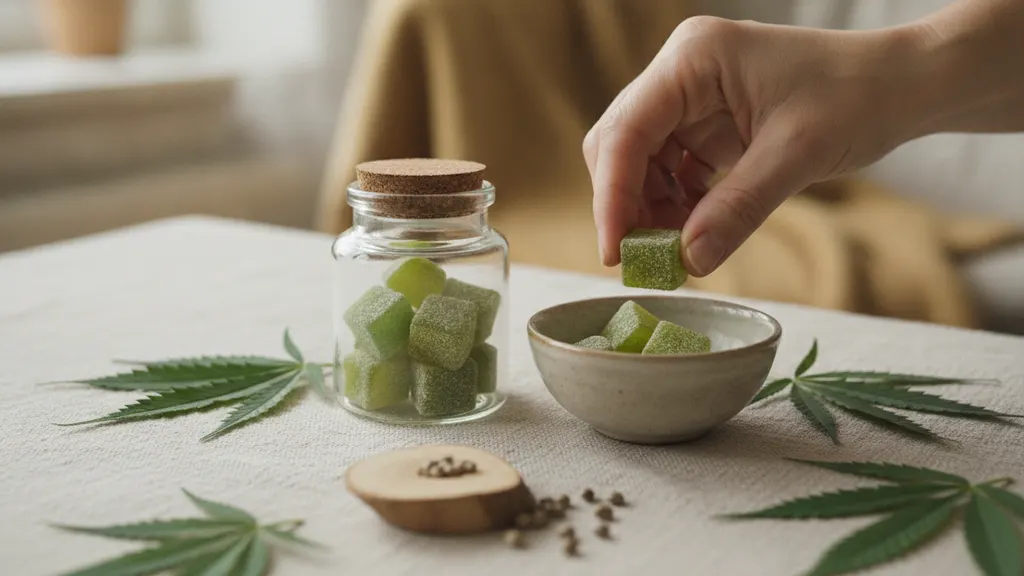
Most THCA gummies on the shelf today are made with extracts that have already been partially converted. That is why finished products can behave a lot more like Delta-9 THC edibles than like eating raw flower. Onset, peak, and duration mirror what our THC onset and duration guide describes: 30 to 90 minutes to feel effects, two to four hours at peak, six or more hours to full clearance for most people. Individual variation is real, and body weight, genetics, and food in the stomach all shift the curve.
What effects people report from THCA gummies
Buyer reports track the underlying chemistry but should not substitute for clinical evidence. Most hemp edibles in this category contain both raw THCA and already-converted Delta-9 THC, producing effects similar to standard hemp Delta-9 products: relaxation, altered time perception, and mild euphoria. The liver converts Delta-9 to 11-hydroxy-THC, making oral doses last longer than inhaled forms at equivalent doses.
Adverse-event reporting also matters. The FDA consumer update on cannabis-derived products lists dizziness, dry mouth, changes in mood, and impaired coordination among common short-term effects. Higher doses can produce anxiety or paranoia in sensitive users. Our post on taking too many THC gummies covers what to do if you dose beyond your comfort. Start low, wait two hours before redosing, and read the COA before you buy.
| Attribute | THCA (raw) | Delta-9 THC |
|---|---|---|
| Binds CB1 receptor | No | Yes |
| Psychoactive when heated | Yes (converts to Delta-9) | Yes |
| Legal under 2018 Farm Bill | If total THC under 0.3% dry weight | If under 0.3% dry weight |
| Detectable on standard urine drug test | Yes, via THC-COOH metabolite | Yes, via THC-COOH metabolite |
Will THCA gummies show on a drug test?
Will THCA gummies show on a drug test? In practice, yes. Employers use immunoassay urine tests that screen for THC-COOH, the metabolite produced after processing Delta-9 THC. The Cleveland Clinic overview of THC detection tests notes this assay cannot distinguish hemp-derived from cannabis-derived THC at any threshold, making the plant source irrelevant to the result.
Commercially sold THCA converts to Delta-9 THC under heat and, to some extent, during digestion, so the metabolite pipeline is identical regardless of whether the plant was classified as hemp or cannabis. SAMHSA mandatory workplace testing guidelines set the immunoassay screening cutoff at 50 ng/mL for THC-COOH, with GC-MS confirmation at 15 ng/mL; those thresholds apply whether the source is a compliant hemp product or illicit cannabis. Detection windows vary by frequency, body composition, and dose: occasional use may clear in 3 to 7 days, regular use in 7 to 21 days, and daily use can register 30 days or more, consistent with ranges the Cleveland Clinic detection overview summarizes. There is no separate legal carve-out for hemp consumers in federal workplace screening programs. If your job requires clean urine, hemp-derived THCA products carry real risk. Our detailed hemp gummies and drug testing guide walks through screening panels and confirmatory tests.
For a closer look at this, see Hemp gummies drug interactions: what to know before combining.
How to shop for hemp-derived THCA gummies safely
Shopping for hemp-derived edibles starts with the Certificate of Analysis, not the marketing copy on the label. Look for both Delta-9 THC and THCA in separate rows, then compute total THC with the DEA formula: Delta-9 plus 0.877 times THCA. Any result above 0.3% by dry weight means the product falls outside the federal hemp definition.
I send every GummyGurl batch, our 25 mg-per-piece gummies included, to ACS Laboratory in Tampa, an ISO-17025 accredited facility audited by the American Association for Laboratory Accreditation, and I check three specific columns before anything ships: total THC using the DEA conversion formula, the full heavy-metal panel, and the microbial count. Reputable brands publish COAs alongside every batch and do not bury unfavorable results. The FDA regulation page for cannabis-derived products warns that heavy metals, pesticides, and residual solvents are common issues in unregulated hemp goods, which makes a full-panel review more important than checking potency alone. ISO-17025 accreditation means the lab operates under a documented quality-management system audited by an independent accreditation body on a regular schedule, not a self-certification a brand can claim without third-party oversight. Our step-by-step post on how to read a COA for hemp gummies covers the exact columns to verify before you order.
Frequently asked questions
Are THCA edibles stronger than regular THC edibles?
Most commercial THCA gummies contain a mix of raw THCA and already-converted Delta-9 THC, so felt strength depends on the extract, not the label. When THCA is heated during manufacturing or hits stomach acid during digestion, portions convert to Delta-9 THC. The 2023 DEA drug scheduling reference uses a total-THC formula that reflects this conversion. Read the COA carefully: add Delta-9 THC plus 0.877 times THCA to see the real dose per serving. Two products labeled 25 mg can feel very different at the same weight.
Can I buy hemp THCA products online in every US state?
No. At least 12 states have passed or introduced THCA-specific hemp legislation, per the NCSL cannabis policy resources. Some ban products above a total-THC threshold, others restrict sales to licensed dispensaries, and a handful ban THCA hemp products outright. Federal law under the 2018 Farm Bill permits interstate commerce of compliant hemp, but shipping into a restricted state can still trigger state-level enforcement. Check your state attorney general or health department page before ordering. Reputable brands block orders to states where the product is prohibited.
How long do THCA edibles take to work?
Onset typically ranges from 30 to 90 minutes after ingestion, similar to Delta-9 THC edibles, according to consumer safety notes summarized by the FDA food labeling and nutrition hub. Peak effects usually arrive between two and four hours in, and duration can stretch to six hours or longer depending on dose, body weight, and food in your stomach. Eating a fatty meal beforehand slows absorption and can push the peak later. Wait a full two hours before considering a second dose to avoid stacking effects.
Will hemp THCA cause a failed workplace drug test?
Yes, THCA gummies can cause a positive urine screen. Standard workplace panels look for THC-COOH, the metabolite your liver produces after processing Delta-9 THC. Because commercial THCA converts to Delta-9 THC through heat and digestion, the metabolite pipeline is identical. Federal SAMHSA workplace resources confirm the 50 ng/mL immunoassay cutoff applies regardless of plant source. If you have a job that screens on a schedule or randomly, hemp-derived THCA products carry real risk. Talk with your employer or choose certified THC-free CBD isolates instead.
What does a good COA for hemp THCA look like?
A trustworthy Certificate of Analysis is dated, batch-specific, and issued by an ISO-17025 accredited third-party lab. It shows Delta-9 THC and THCA in separate rows so you can compute total THC. It also includes screens for heavy metals, pesticides, residual solvents, and microbial contamination. The FDA cannabis-product guidance page flags contamination as a common issue in unregulated hemp goods. If a brand hides COAs behind an email request, chooses a lab you cannot verify, or shows expired reports, walk away and shop elsewhere.
Are hemp THCA products safe for beginners?
For a first-time user, start with 2.5 to 5 mg of total THC and wait a full two hours before considering more. Because most hemp edibles in this category convert to Delta-9 THC, the dose-response rules that apply to Delta-9 edibles apply here. The Mayo Clinic patient education library notes oral cannabinoids produce longer, sometimes more intense effects than inhaled forms. Beginners should not drive, operate machinery, or drink alcohol while dosed. Avoid THCA if you are pregnant, breastfeeding, on prescription sedatives, or under 21.