
Can you actually get on a plane with your usual gummies in 2026? Short answer: flying with hemp gummies is allowed under federal rules when the product contains 0.3% delta-9 THC or less, but TSA officers can still refer anything that looks off to law enforcement, and a handful of states will treat your legal hemp-derived edible as a controlled substance the moment you land. Jessica has formulated hemp edibles tested by ACS Laboratory since 2021 and carried her own batches through checkpoints in fourteen states. Here is what to pack, what to leave home, and what to do at the checkpoint.
What TSA's 2026 policy actually says about flying with hemp gummies
The Transportation Security Administration's own guidance is clearer than most travelers think. TSA states that hemp-derived products, including CBD oil and edibles containing no more than 0.3% delta-9 THC on a dry weight basis, are allowed in both carry-on and checked bags, matching the federal definition set out by the 2018 Farm Bill.
The agency also spells out its stance on cannabis-adjacent products on its official medical marijuana and CBD page, and its in total screening authority is described on the TSA travel hub. Two things matter for you as a passenger. First, TSA agents are not looking for weed. Second, if they find something during a routine bag check that appears to violate federal or state law, TSA policy says they must refer it to local law enforcement, and what happens after that is out of TSA's hands.
That means the risk of flying with hemp gummies is rarely at the X-ray belt. It is at the intersection of federal permission, unfamiliar packaging, and a local officer who may not have deep knowledge of hemp law. Documentation, sealed packaging, and product choice do most of the work of keeping the interaction short and boring, which is exactly what you want.
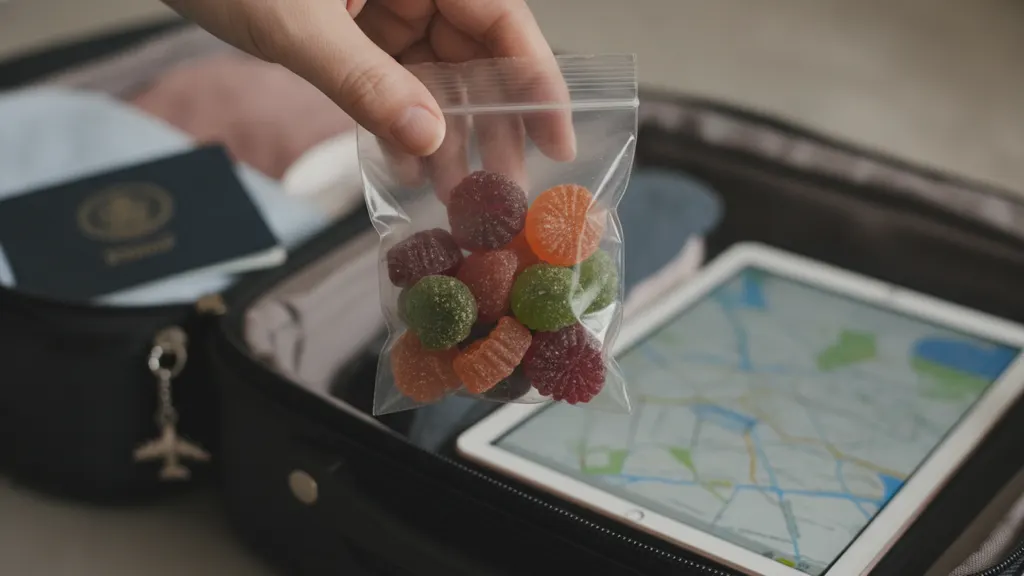
State laws that can bite you when flying with hemp gummies
Federal legality is only half the story. Airports sit inside states, and when you deplane, state and local law controls the ground you walk on. As of 2026, Idaho, Kansas, and Nebraska maintain laws that treat most cannabis-derived products as controlled substances, regardless of whether the delta-9 THC is under the federal 0.3% threshold. Other states have narrower carve-outs, age limits, or product-type restrictions that can trip up an out-of-state traveler.
The National Conference of State Legislatures keeps a rolling tracker of state cannabis and hemp policy that is worth checking within a week of your trip. Layer on USDA's Domestic Hemp Production Program, which sets the federal 0.3% delta-9 THC ceiling, and the DEA's scheduling page, which still lists marijuana on Schedule I, and the map gets messier: a product that is federally legal hemp can still be illegal cannabis under a specific state's definitions.
Some travelers ask whether flying with hemp gummies is safer if they only fly between two obviously legal states. It is safer, but it is not zero risk. Layovers count. If your itinerary routes you through Boise, Wichita, or Omaha, you are legally on the ground in that state for the connection, even if you never leave the terminal.
What happens at the checkpoint when flying with hemp gummies
Most bags never get manually inspected. If yours does, the officer opening it is usually looking at the shape and density of what alarmed the X-ray, not the label. When they see gummies, the common outcomes are: they close the bag and wave you through, they ask what the product is and accept your explanation, or they call over a supervisor. Only a small share of cases escalate beyond that. That is consistent with how the DEA and federal drug enforcement priorities treat low-THC hemp products.
Escalation looks like a call to airport police. That is when your paperwork matters. A COA on your phone that matches the batch number on the bottle, plus the TSA screenshot, gives the officer a way to close the file quickly. If you are polite, non-defensive, and short with your answers, most people flying with hemp gummies end the airport interaction without a citation. The worst outcomes tend to happen when travelers are combative, when packaging is missing, or when the product looks homemade.
My own experience shows how short these interactions can be. In April 2025, I flew Charlotte Douglas International to Denver International carrying a sealed bottle of our 25 mg broad-spectrum gummies from batch BN-2503. A manual bag check pulled the bottle at Charlotte. The officer looked at the label, I opened the COA on my phone and pointed to the delta-9 THC row showing 0.29%, and the interaction was closed in under two minutes. Flying with hemp gummies across dozens of trips since starting GummyGurl has taught me that original packaging and a clean COA do most of the work before a word is spoken.
What the FDA says about labeling
Labels are a real signal to officers. The FDA's page on cannabis and cannabis-derived products is blunt that most hemp-derived edibles are not FDA-approved and cannot make disease claims. Reputable brands still print the cannabinoid content, batch number, and manufacturer address. A bottle with none of that on it looks suspicious to anyone opening a bag, even if the contents are legal.
Documents to carry when you are flying with hemp gummies
Bring three things and you cover almost every question you could face at a checkpoint or a gate area police interaction. Each can be verified in seconds by a screening officer, and together they reduce a potential referral to a brief label check.
First, the product in its original sealed container with the ingredient panel and cannabinoid content visible. Second, a Certificate of Analysis for that specific batch number, showing delta-9 THC at or below 0.3% by dry weight, per the standard laid out under the 2018 Farm Bill. Third, a saved screenshot of TSA's medical marijuana and CBD guidance so you are not relying on airport Wi-Fi.
If your product contains cannabinoids beyond CBD, like delta-8, HHC, or THCP, add a note to yourself about the source cannabinoid law in your departure and arrival states. The SAMHSA substance use resource page and CDC's marijuana health effects overview are not legal resources, but linking your understanding of the product back to public health sources helps you answer questions calmly if asked. If you want a deeper primer on reading a certificate of analysis, our internal guide on how to read a COA for hemp gummies walks through what each row actually means.
Practical steps before you fly with hemp gummies
Flying with hemp gummies goes smoothest when you treat the security checkpoint as a predictable five-step process rather than an improvised conversation. Each step takes under two minutes, and together they cover the scenarios that trip up travelers most often, from a routine X-ray wave-through to a gate-area police call in a restrictive state.
| Step | Why it matters | Time |
|---|---|---|
| Confirm state-of-arrival hemp status | State law, not federal, controls arrival risk | 5 min |
| Save the batch COA to your phone | Fastest proof the delta-9 THC is at or below 0.3% | 2 min |
| Keep product in original sealed bottle | Repackaged gummies look like unlabeled edibles | 1 min |
| Screenshot TSA CBD guidance | Works offline in the terminal | 1 min |
| Pack in carry-on, not checked | You are present if TSA needs to ask about it | 2 min |
If your trip is short or your destination state is one of the restrictive three, the calmest path is often to skip the trip supply entirely. You can order fresh product to your home address to arrive the day you return, or find a compliant retailer near your destination. Our post on how to store hemp gummies covers keeping a fresh batch potent while you are away, which is often easier than gambling on a checkpoint. For readers still weighing product choices, our overview of full spectrum vs isolate hemp gummies and the primer on is hemp-derived THC legal under the 2018 Farm Bill are the two most useful companions to this piece.
We cover the details separately in Hemp gummies drug interactions: what to know before combining.
Frequently asked questions
Can I bring hemp gummies in my carry-on in 2026?
Yes, TSA permits hemp-derived products containing 0.3% delta-9 THC or less by dry weight in both carry-on and checked luggage, per its published What Can I Bring guidance updated for 2026. That threshold matches the federal definition set by the Agricultural Improvement Act of 2018, commonly called the 2018 Farm Bill, which moved hemp from the Controlled Substances Act to USDA oversight. TSA agents do not screen specifically for cannabis, but if a substance appears to violate federal or local law during routine screening, they are required to refer it to law enforcement. Keeping gummies in original labeled packaging with a batch COA on your phone makes it easier to demonstrate hemp compliance if a bag is opened. Flying with hemp gummies in a carry-on rather than checked luggage also means you are present to answer any questions if a bag is flagged. Rules can shift at any time, so recheck the TSA site the week you fly.
What states are dangerous to land in with hemp gummies?
Idaho, Kansas, and Nebraska maintain the strictest posture, treating many cannabis-derived products as controlled regardless of THC percentage under state law. Other states, tracked in the NCSL state medical cannabis laws database, have narrow hemp definitions, local ordinances, or age gates that create real arrival risk. Even where hemp is legal, an airport is often policed by state or municipal officers, not federal. Idaho's Uniform Controlled Substances Act, for instance, does not include a hemp carve-out tied to the federal 0.3% dry-weight threshold, a gap that state legislators have not closed as of 2026 despite federal Farm Bill passage in 2018. If your destination is one of the restrictive states, the safer plan is to ship a fresh order to your home address instead of flying with product, or simply travel without gummies.
What documents should I carry for TSA and airport police?
Carry the product in its original sealed packaging, a printed or digital Certificate of Analysis matching the batch number, and a screenshot of the TSA medical marijuana and CBD entry. The COA should show delta-9 THC at or below 0.3% by dry weight, the federal hemp threshold set by the 2018 Farm Bill and administered by USDA under its Domestic Hemp Production Program. A properly issued third-party COA will also list the testing laboratory's accreditation number, the specific batch or lot number matching your bottle, and a cannabinoid panel showing each compound as a percentage of dry weight. If an officer does not recognize what a COA is, point to the delta-9 THC row and the value below 0.3. Documents do not guarantee anything, but they let you calmly answer questions and give a screening officer a fast path to close the interaction if they choose to.
What happens if TSA finds hemp gummies in my bag?
Most of the time, nothing dramatic. Screening officers are focused on weapons and explosives, not edibles. If a bag alarms and gummies come out, an officer usually asks what the product is, may look at the label, and either clears it or calls a supervisor. Only a small fraction of edible products pulled for inspection result in anything beyond a brief conversation. When there is any doubt about legality, TSA policy is to refer the item to airport law enforcement, and outcomes then depend on state and local law. In Idaho, state code classifies cannabis-derived products regardless of THC percentage, so an airport police referral there carries substantially more risk than the same interaction at a Denver or Los Angeles checkpoint. Consequences range from being told to discard the product to a citation or, in worst cases, an arrest under state controlled-substances statutes.
Is flying with hemp gummies internationally a bad idea?
For most travelers, yes. International destinations do not follow the US Farm Bill, and many countries classify any cannabis-derived product as a controlled substance with severe penalties. The DEA still lists marijuana under Schedule I, and foreign customs authorities often take a broader view of what qualifies as marijuana than US regulators do. Japan's Cannabis Control Act, for example, prohibits importing any product derived from cannabis leaves or flowers, with possession penalties reaching five years imprisonment, and enforcement does not distinguish between hemp and high-THC marijuana. Singapore's Misuse of Drugs Act applies zero tolerance to any detectable cannabinoid. Even Canada, which has legalized adult-use cannabis, prohibits taking cannabis products across its border in either direction. The safe default for international trips is to leave hemp gummies at home and buy locally legal alternatives at your destination when available.
Do TSA PreCheck or CLEAR change anything for hemp gummies?
No. TSA PreCheck and CLEAR change identity verification and lane speed, but the physical screening rules for what is inside your bag are identical. Your carry-on still passes through X-ray, and if something needs a manual check, an officer will open the bag regardless of program status. The rules governing flying with hemp gummies come from the 2018 Farm Bill and TSA guidance, not from your trusted-traveler enrollment status. Treat the checkpoint experience the same way whether you are in a standard line or a trusted-traveler lane, and pack the same documentation either way.