
"I've done CBD, I've done CBG, what's left?" A customer asked me that last month and the answer is cannabichromene. CBC gummies sit at the far end of the minor cannabinoid shelf, and the compound is not new at all: it was isolated in 1966, the same era that gave us THC. It works through a different door in the body than CBD does, and that difference is the whole reason it is worth a look.
What cannabichromene is and how CBC ends up in your gummy
Cannabichromene is the hemp-derived cannabinoid behind CBC gummies, built by the plant from the same starting material as CBD and THC. All three trace back to cannabigerolic acid, the precursor chemists nickname the mother cannabinoid. Which enzyme grabs that precursor decides whether the plant makes CBC, CBD, or THC.
In hemp, the enzyme CBCA synthase converts cannabigerolic acid into cannabichromenic acid. Heat and time then strip a carboxyl group off, producing neutral CBC. That decarboxylation step happens during drying, curing, or gentle heating in a lab. It is the same chemistry described in our piece on THCA and why raw hemp acids convert.
The catch is yield. Modern hemp cultivars have been bred for CBD output, so CBC shows up as a fraction of a percent in most harvests. Producers isolate it through chromatography, then blend measured milligrams into a gummy base. That extra separation step is why CBC gummies cost more per milligram than a plain CBD gummy off the same production line.
The 1966 date matters more than it sounds. Raphael Mechoulam and Yehiel Gaoni, the same team behind THC's structure, characterized cannabichromene in that early wave of cannabis chemistry. So CBC is not a novel compound invented by a marketing department. It has been sitting in the literature for six decades while research money went elsewhere.
How CBC acts differently from CBD and CBG
Here is the mechanical difference behind CBC gummies. CBD and CBG both interact with the classical cannabinoid receptors in a loose, indirect way. CBC barely touches them at all. Instead it goes after a separate family of ion channels called transient receptor potential channels, and that is what makes it chemically distinct.
Receptor pharmacology work catalogued in the PubMed cannabinoid receptor pharmacology literature shows CBC has weak binding affinity at both CB1 and CB2, while acting as a potent activator of TRPA1 and, to a lesser degree, TRPV1. Those channels sit on sensory nerve endings and participate in pain and inflammation signaling. TRPV1 is the same channel capsaicin from chili peppers hits.
Practically, that means CBC gummies are not a stronger CBD. They are a different lever. If CBD is a broad, low-volume signal across many targets, CBC is narrower and aimed at a channel family CBD engages much less. This is also why CBC rarely appears alone; formulators pair it with cannabinoids that cover other ground. Our guide to CBG as a minor cannabinoid covers the third member of this group.
What the research actually says about cannabichromene effects
Short version: the mechanism work is solid, the human outcome data is not there. Almost everything published on CBC is preclinical, meaning cell cultures and animal models. That is not a reason to dismiss it. It is a reason to keep expectations calibrated.
The study people cite most is a 2013 paper in Neurochemical Research by Shinjyo and Di Marzo, indexed in the PubMed record for the 2013 Shinjyo and Di Marzo neural stem cell study. Working with adult neural stem progenitor cells in vitro, they found CBC promoted proliferation and viability of those cells, and researchers read that as a possible neuroprotective mechanism worth following, though it remains a dish, not a person. That distinction is the one the National Center for Complementary and Integrative Health cannabinoid evidence overview keeps making about cannabinoids generally: preliminary findings are common, confirmed human results are rare, and the FDA consumer update on cannabis-derived products is blunter still, noting that most CBD and minor cannabinoid products on the market have not been evaluated for safety or effectiveness.
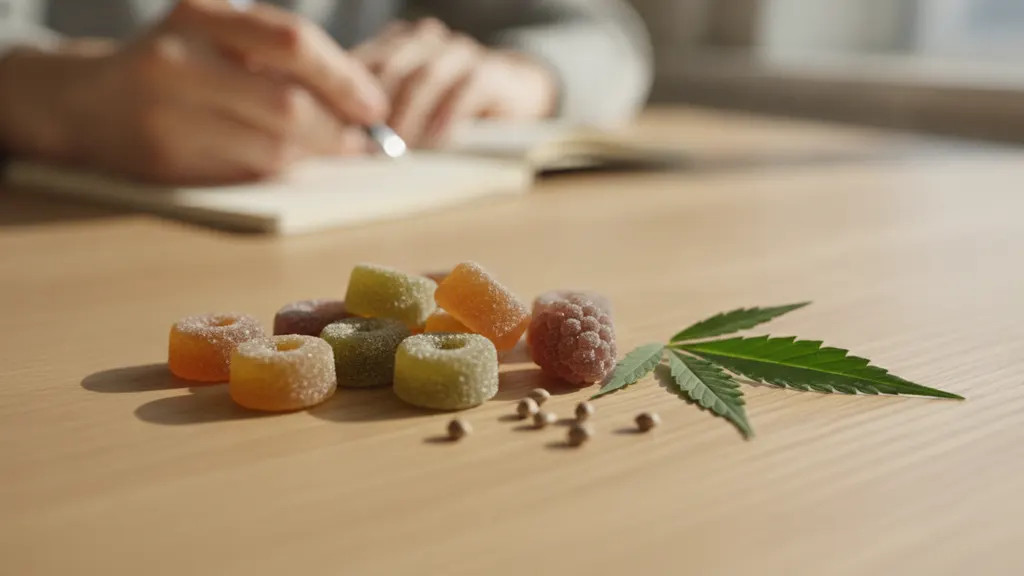
So what do you do with that? Treat cannabichromene effects as an open question rather than a settled benefit. I sell these products and I still say that, because the alternative is making claims the science has not earned. Nothing here diagnoses or addresses any condition, and no hemp product should be described that way.
How to shop for CBC gummies without getting burned
The buying problem with CBC gummies and other minor cannabinoid products is that the front label is cheap and the lab test is not. A jar can say CBC in large type while containing two milligrams per gummy. The certificate of analysis settles it, and a brand that will not show you one has told you everything.
Work through this list before you buy:
| What to check | What good looks like | Red flag |
|---|---|---|
| COA availability | Batch-matched, dated within 12 months, from an ISO 17025 lab | No COA, or a COA with no batch number |
| CBC milligrams | Listed per gummy on the potency panel | Only a total blend figure for the jar |
| Delta-9 THC | At or under 0.3 percent dry weight | Not tested or omitted from the panel |
| Contaminant panels | Pesticides, heavy metals, residual solvents, microbials | Potency only |
| Label claims | Plain description of contents | Disease claims or FDA language |
That last row is not a style preference. The FDA warning letter record for cannabidiol-related products is a running list of companies cited for exactly that behavior. A brand willing to make a medical claim it cannot support is a brand cutting corners somewhere you cannot see.
On contaminants, hemp is a bioaccumulator, meaning it pulls metals and residues out of soil into plant tissue. USDA hemp production program guidance governs how crops are sampled and tested at the farm level, but that testing is about THC compliance, not your finished gummy. Only the product-level COA covers that. If you are new to reading these, our full spectrum versus broad spectrum comparison walks through the panel line by line.
Where CBC fits in a full-spectrum routine
Most people should not buy CBC gummies as a standalone product. It makes more sense as one component of a blend, because the argument for minor cannabinoids rests on them working alongside each other rather than in isolation. That argument has a name: the entourage effect.
The idea is that cannabinoids and terpenes in a whole-plant extract modify each other's activity, so a full spectrum product behaves differently from the sum of its isolated parts. The evidence is suggestive rather than proven, and I would call it a reasonable working hypothesis. Our breakdown of the entourage effect in hemp gummies gets into where the support is thin.
If you want to try cannabichromene, the sane path is full spectrum CBC gummies that list CBC on their COA alongside CBD, plus whatever else the extract carries. Start at the low end of the label's serving range, hold it for a week, and pay attention. Changing two variables at once tells you nothing.
One legal note. Whatever the blend, CBC gummies stay federally lawful only if the product meets the 0.3 percent delta-9 THC dry weight threshold set in the 2018 Farm Bill text at congress.gov. State law varies on top of that. Before traveling with any hemp product, check your destination state, because a legal purchase at home is not automatically legal elsewhere.
Frequently asked questions
Will CBC gummies make me feel high?
CBC is not considered intoxicating. It binds weakly at the CB1 receptor, which is the receptor most associated with the head-change people describe from THC, so on its own CBC does not produce that effect. What you may notice instead is subtle: a slightly different body feel compared to a CBD-only gummy. If your gummy is full spectrum, it also carries trace delta-9 THC under the 0.3 percent dry weight limit written into federal law, which you can read at congress.gov. At high servings that trace amount can add up, so read the panel.
How is CBC different from CBD in a gummy?
Both come from the same precursor molecule in hemp and both bind weakly at CB1 and CB2. The difference shows up at the TRP channels. CBC is a potent activator of TRPA1, the channel family described in receptor pharmacology work indexed at PubMed, while CBD spreads its activity across a wider set of targets including serotonin receptors. In practice, brands position CBD as the general-purpose cannabinoid and CBC as a blend component. Most people meet CBC inside a multi-cannabinoid formula rather than on its own.
Is there real research on cannabichromene or is it all marketing?
There is real research behind cannabichromene, but nearly all of it stops at the lab bench rather than the clinic. The 2013 Neurochemical Research paper by Shinjyo and Di Marzo, findable through PubMed, tested CBC on adult neural stem progenitor cells in a dish and found it raised proliferation and viability. That is a cell culture result, not a human outcome. The National Center for Complementary and Integrative Health is direct about how thin the human evidence base is across most cannabinoids. So the honest summary is: interesting mechanism, early stage, no human trials to point at yet.
Why are CBC gummies more expensive than CBD gummies?
Supply, mostly. Hemp cultivars have been bred for decades toward high CBD output, so CBC shows up in small amounts and needs extra separation steps to isolate at usable purity. Fewer labs run it, batch sizes are smaller, and the input cost per milligram lands higher than CBD. Because of that, some products advertise CBC while including a token dose. The fix is the certificate of analysis: check the milligrams per gummy on the potency panel rather than the number printed on the front of the jar.
Can I take CBC gummies with my prescription medication?
Ask your prescriber first, and do it before your next dose rather than after. Cannabinoids are processed by the same liver enzyme families that handle a long list of common prescriptions, which is why interaction warnings appear on FDA labeling for approved cannabinoid drug products. CBC specifically has less interaction data than CBD, so there is less to reassure anyone with. If you take blood thinners, seizure medication, or anything with a narrow therapeutic window, treat that conversation as the required step, not an optional one.
How long does CBC take to kick in?
Like any edible, CBC gummies need an hour to two hours to take effect, because the gummy has to clear your stomach and pass through the liver before anything reaches circulation. Food matters here. A gummy taken on an empty stomach behaves differently from one taken after a meal with fat in it. The mistake people make is redosing at the 45 minute mark because nothing has happened yet. Take one, set a timer for two hours, and judge it then. The Cleveland Clinic covers edible onset timing in its cannabis explainers.